
Jordan in 6 Days: Amman, Petra, Wadi Rum & the Dead Sea
A tightly plotted week that runs from Amman's hills to the rose-red canyons of Petra, a night under the stars in Wadi Rum, and a final salty float on the lowest point on Earth.
6 days in Amman + 3 more
Jordan packs an outsized amount of wonder into a country roughly the size of Portugal. In one compact week you can stand in a 2,000-year-old Roman theater, walk the Siq to Petra's Treasury at the exact spot Indiana Jones did, sleep in a Bedouin camp beneath a sky thick with stars, and float weightless on the Dead Sea, 430 meters below sea level. The distances are short and the roads are good, which is why a driving loop works so well here.
Jordanians are famously hospitable, and the food is a highlight in its own right: mansaf (lamb in fermented yogurt over rice), knafeh (a molten cheese-and-syrup dessert perfected in Amman), fresh mezze, and endless small cups of cardamom coffee and sweet mint tea. English is widely spoken in tourist areas, the currency is the Jordanian dinar (JOD), and the country is regarded as one of the safest and easiest to travel in the region.
A few practical notes: the Jordan Pass is close to essential (it bundles Petra entry and, if you stay three or more nights, waives the tourist visa fee). July is hot, with Petra and Wadi Rum often near 38-40C by midday, so start early, carry water, and save afternoons for shade or the pool. This itinerary assumes a rental car or private driver, which gives you the freedom the sights reward.

Arrival, the Citadel & Downtown Amman
Amman Citadel · David Bjorgen / CC BY 2.5Land, drop your bags, and head straight up to Amman's headline sight while the afternoon light is warm. The hilltop Citadel gives you the whole city in one sweep and a fast primer on Jordan's layered history.
Amman's ancient acropolis crowns the city's highest hill, with the towering columns of the Temple of Hercules, the domed Umayyad Palace, and a small museum. Entry is included with the Jordan Pass (otherwise about 3 JOD), and the views over the downtown bowl are unmatched at golden hour. Budget about 60-90 minutes.
A superbly preserved 2nd-century amphitheater carved into the hillside, seating 6,000 and still used for events. It sits at the foot of the Citadel in downtown, so pair the two; climb to the top row for the classic photo. Included with the Jordan Pass.
Ease into downtown Amman on foot as the heat lifts and the souks come alive. This is the city at its most atmospheric.
This walkable ridge in Jabal Amman is lined with cafes, boutiques, and viewpoints. Grab a mint-lemon juice, browse the shops, and watch the city lights flicker on over the valley.
Your first Jordanian meal should be memorable. Downtown Amman is the place for it, from classic grills to the country's most famous dessert.
An Amman institution since 1956, this bare-bones downtown falafel-and-hummus joint has fed kings and backpackers alike. A full meal of falafel, hummus, fuul, and fresh bread costs just a few dinars. Cash only, always busy, utterly essential.
A refined take on Jordanian home cooking in a restored villa on Rainbow Street, with a lovely terrace. Order the mansaf or the mixed grill and save room for the mezze. Mains around 8-14 JOD.
The downtown hole-in-the-wall widely credited with the city's best knafeh, the syrup-soaked cheese pastry topped with crushed pistachio. Join the local queue at the counter for a warm square that costs under 1 JOD. The perfect first-night sweet.

Day Trip North: Jerash & Ajloun Castle
Jerash · Petar Milošević / CC BY-SA 4.0Fuel up early before the drive north; Jerash is best explored before the midday heat.
A calm, design-forward cafe in Jabal al-Weibdeh with excellent espresso and light breakfasts. A good spot to caffeinate before heading out.
A farm-to-table favorite with a terrace view, serving Levantine breakfast plates of labneh, za'atar, eggs, and fresh bread. Order the traditional breakfast spread and a sage tea.
Spend the day among northern Jordan's greatest hits: Jerash, one of the best-preserved Roman provincial cities anywhere, and the Crusader-era mountain fortress at Ajloun. It is about 50 minutes to Jerash from Amman, and a guided trip takes the logistics off your plate.
A well-priced guided day trip pairing Jerash's colonnaded streets, oval plaza, and hilltop temples with the 12th-century Ajloun Castle and its sweeping Jordan Valley views. Expect around 6-7 hours with hotel pickup. Walk Jerash's Cardo, stand in the Oval Plaza, and catch the daily gladiator-and-chariot show if it's running.
A highly rated private option that adds Umm Qais, the ruined Greco-Roman city of Gadara with views over the Sea of Galilee and Golan Heights, to Jerash and Ajloun. A fuller, more ambitious day for history buffs.
Back in Amman, choose between a deep dive into the city's food or an easy neighborhood meal.
A small-group, 3-hour guided crawl through downtown Amman sampling falafel, knafeh, fresh juices, and street sweets with a local guide who explains what you're eating. A fun, filling way to spend your last Amman evening. Book in advance as groups are kept small.
Elegant Lebanese-Jordanian dining in a 1950s villa near the First Circle, a favorite for special meals. The mezze are excellent and the setting is quietly upscale. Mains around 10-16 JOD.

Drive to Petra & the Walk to the Treasury
Al-Khazneh · Al_Khazneh_Petra.jpg: Graham Racher from London, UK derivative work: MrPanyGoff / CC BY-SA 2.0Grab an early breakfast in Amman and hit the road; the Desert Highway is quick and you want to reach Petra with the afternoon ahead of you.
Most Amman hotels lay on a generous Levantine breakfast buffet. Eat well, fill a water bottle, and get on the road by around 8am to reach Wadi Musa by lunchtime.
Arrive in Wadi Musa, check in, and grab a quick lunch before entering Petra when the tour buses start thinning out.
A warm, family-run spot in Wadi Musa serving generous Jordanian home cooking, including galayet bandora (tomato stew) and maqluba. A good-value, friendly welcome to town. Mains around 5-9 JOD.
Enter Petra in the early afternoon and walk the Siq as the light softens. Entry is included with your Jordan Pass; a single-day ticket is 50 JOD if bought separately.
The 1.2 km walk through the Siq, a slot canyon of towering, banded rock, ends at Petra's most famous monument. Continue past the Treasury to the Street of Facades, the Royal Tombs, and the Roman theater. Afternoon light is kinder for photos and the crowds ease after 3pm. Wear sturdy shoes and carry at least 2 liters of water.
On the right nights, Petra reopens after dark for a candlelit spectacle in the Siq. Otherwise, unwind in town.
On Monday, Wednesday, and Thursday evenings, the Siq and Treasury are lit by roughly 1,500 candles, with Bedouin music and tea at the end. It costs about 17 JOD (not covered by the Jordan Pass) and buying ahead is wise. Atmospheric, if crowded; go for the mood, not the history.
Set inside a 2,000-year-old Nabataean rock tomb at the Petra Guest House, this is one of the world's more remarkable places for a drink or a light dinner. Worth a stop even for one glass.
Dinner in Wadi Musa leans hearty and traditional, perfect after a day on your feet.
A long-running local favorite on the main roundabout, serving reliable grills, mezze, and the slow-cooked lamb zarb. Casual and central, mains around 6-10 JOD.
A hands-on cooking-class dinner where you prepare a Jordanian mezze and main with local cooks, then eat what you made. Fun and social; reserve ahead. Around 35 JOD per person.

Petra's Monastery, then into Wadi Rum
Ed-Deir, Petra · Azurfrog / CC BY-SA 3.0Be at the gate for opening. The early hours are cooler, quieter, and the best time to tackle the big climb.
Petra opens at 6am. Eat light and early (many hotels near the gate do a 5:30-6am breakfast for exactly this) so you can climb to the Monastery before the heat builds.
Spend the cool morning hours going deeper into Petra, ideally up to the Monastery, the site's largest and arguably most jaw-dropping facade.
A roughly 800-step rock-cut staircase climbs about 45-60 minutes to Ad-Deir, a 47-meter-wide monument even larger than the Treasury, with far fewer people. Cafes near the top sell drinks, and a short scramble reaches a viewpoint over the Wadi Araba. Go early before the sun hits the stairs.
An alternative climb (about 600 steps) to a Nabataean altar with commanding views over the whole city. A great option if you'd rather loop back down a different trail past the Garden Tomb and Lion fountain.
Exit Petra, collect your bags, and grab a quick bite before the short drive south to the desert.
A dependable, view-blessed spot in Wadi Musa for a final Petra-town meal of mezze, grills, and fresh salads before you hit the road. Mains around 6-10 JOD.
Drive about 1.5 to 2 hours south to Wadi Rum, the vast protected desert of towering sandstone jebels and red dunes that doubled for Mars on film. Meet your camp, drop your bags, and head out for a first taste of the sand.
The drive from Petra to the Wadi Rum village gate is roughly 105 km (1.5-2 hours). Camps arrange 4x4 pickup from the visitor center, since private cars cannot drive into the protected area. Arrive with time to settle before the sunset run.
Wadi Rum at sunset is the whole point: the rock walls glow crimson and the silence is total. Most camps include a short sunset drive to a dune or viewpoint.
Climb a red dune or rock ledge to watch the sun drop behind the jebels, then return to camp for zarb, the Bedouin dinner slow-cooked in an underground sand oven. Afterward, the star-gazing is extraordinary; Wadi Rum has almost no light pollution.
Dinner is at your desert camp, a communal affair under the stars.
Nearly all Wadi Rum camps include a traditional buffet dinner built around zarb (lamb or chicken and vegetables roasted in a sand pit), with rice, mezze, and bread. Sweet tea flows late into the evening by the fire.
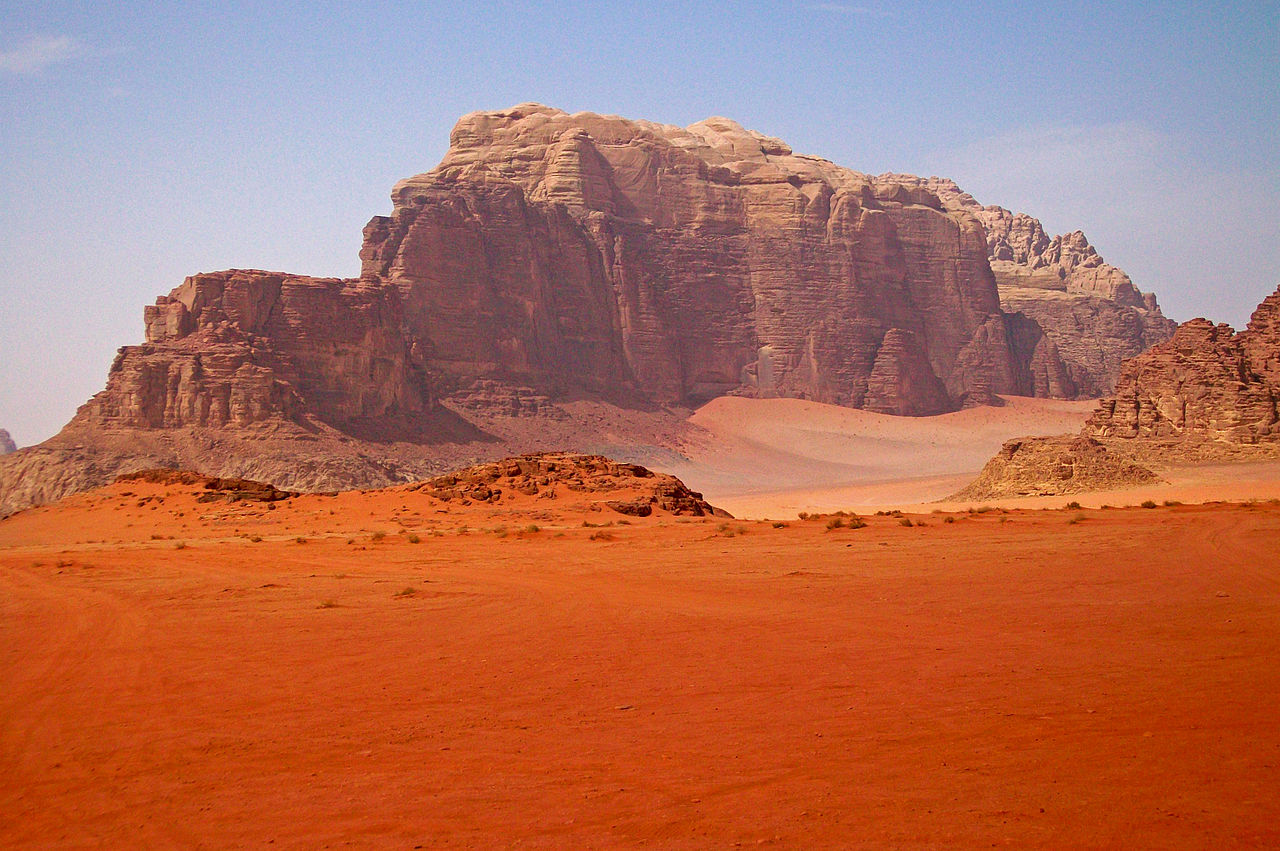
Wadi Rum Jeep Safari & On to the Dead Sea
Wadi Rum · Daniel Case / CC BY-SA 3.0Wake for sunrise over the desert, then a camp breakfast before your morning tour.
Watch the first light turn the rock walls gold, then eat the camp's spread of eggs, labneh, hummus, bread, and cardamom coffee. Early mornings are the coolest, clearest time to be out in the sand.
Explore Wadi Rum's highlights by 4x4 before the midday heat, hitting canyons, dunes, natural arches, and Lawrence-era sites with a Bedouin guide.
A morning 4x4 loop of the desert's greatest hits: Lawrence's Spring, Khazali Canyon petroglyphs, the red sand dune, and a natural rock arch, with time to scramble, sandboard, and stop for Bedouin tea. Around 4 hours, leaving your afternoon free to travel. Excellent value.
If you'd rather trade the Dead Sea time for a deeper desert day, this full-day 4x4 covers Lawrence Spring, the red dune, Khazali Canyon, arches, and Lawrence's House with a Bedouin lunch. Best only if you're willing to reach the Dead Sea after dark.
Eat at camp or grab something in Wadi Rum village before the drive north.
Most camps serve a simple lunch, or stop at a cafe in Wadi Rum village near the visitor center. Fuel up and top off water for the roughly 3.5-4 hour drive to the Dead Sea.
Drive north from the desert to the Dead Sea, the lowest point on Earth, dropping over 1,400 meters in elevation along the way.
The drive from Wadi Rum to the Dead Sea resort strip is about 300 km (3.5-4 hours) via the Desert Highway and Dead Sea Highway. Aim to arrive with time to check in and catch sunset over the water and the hills of the West Bank beyond.
Cap the day with the experience the Dead Sea is famous for, ideally as the sun sets over the water.
The water is roughly 34% salt, so you bob like a cork; slather on the mineral-rich black mud, rinse in the sea, then shower off. Don't shave beforehand and keep the water out of your eyes. Sunset here, with the sun sinking behind the Judean hills, is spectacular.
The Dead Sea resorts cluster their dining on-site, since restaurants are sparse outside the hotels.
Most Dead Sea hotels run generous international-and-Levantine buffets plus a specialty restaurant or two. After a long travel day, the convenience is welcome; many have terraces facing the water.

Dead Sea Morning & Departure
Red Sea–Dead Sea Water Conveyance · Makeandtoss / CC0Take a slow breakfast facing the water; you've earned it on the last morning.
Dead Sea hotels do lavish breakfast buffets. Eat by the water, then squeeze in one more float or a spa treatment before checkout.
Use the cooler morning for a final float and mud treatment, or make a short cultural stop on the way to the airport. Either way, keep an eye on your flight time.
One last bob in the buoyant water and a mineral mud wrap before you rinse off and check out. Most resorts offer day-use of the beach and pools after checkout for a small fee if your flight is late.
If your departure is in the afternoon or evening, detour via Mount Nebo, where Moses is said to have viewed the Promised Land (entry about 3 JOD), and Madaba, famous for its 6th-century mosaic map of the Holy Land. Both are roughly 30-45 minutes up from the shore and broadly on the way to the airport. Add about 2-3 hours total.
Grab a last Jordanian meal near Madaba or the airport before you fly.
A beloved restaurant set in a restored old stone house in central Madaba, serving excellent mezze, grills, and fresh bread from the clay oven. A fitting final meal if you routed via Mount Nebo. Mains around 7-12 JOD, about 35 minutes from the airport.
If you're heading straight to the airport from the shore, the modern terminal has cafes and a few sit-down options landside and airside. Allow at least 2.5-3 hours before an international flight.
Pick your base
For first-timers, Downtown (Al-Balad) puts you steps from the Roman Theater, souks, and the best cheap eats, though it is noisy. Jabal Amman and Jabal al-Weibdeh are the leafy, cafe-lined districts favored by locals and design-minded travelers, walkable to Rainbow Street. Abdali and the Fifth Circle area hold the big international hotels and are handy if you want a pool and easy airport access.
A reliable, well-run full-service hotel in the Shmeisani business district with a pool, several restaurants, and easy taxi access to downtown. A strong mid-range choice for a first or last night in the city.
A friendly, backpacker-favorite base in the heart of downtown, walkable to the Roman Theater and souks, with helpful staff who can arrange drivers and tours. Great value for travelers who want to be in the thick of Al-Balad.
Amman's marquee luxury address, near the Fourth and Fifth Circles, with a spa, rooftop bar, and impeccable service. The splurge pick if you want to bookend a busy trip in comfort.
The closest full-service hotel to the Petra gate, a short walk from the entrance, with comfortable rooms and a rooftop pool. The best-located mid-range pick for an early start.
Literally at the Petra gate (its Cave Bar occupies a Nabataean tomb), so you can roll out of bed and into the Siq. Rooms are simple but the location is unbeatable.
A handsome, marble-and-woodwork five-star directly across from the visitor center, with a spa and rooftop terrace. The most comfortable base in Wadi Musa and steps from the entrance.
A well-regarded, authentically run Bedouin camp with comfortable tents, good food, and warm hosts who lead the jeep tours themselves. A solid all-round choice for the classic experience.
A long-established, larger camp with reliable service, hearty zarb dinners, and easy tour logistics. Good for those who want a bit more structure and facilities.
Famous for its Martian-style bubble domes with transparent panels for stargazing from bed, set beneath dramatic cliffs. The memorable splurge for a night in the desert.
A comfortable, family-friendly resort with a large pool complex, private beach, and good-value packages. A dependable mid-range base for the final night.
One of the longer-running, better-value properties on the strip, with a medically oriented spa and easy beach access. A sensible choice if you want the Dead Sea experience without the five-star price.
The showpiece of the shore, a sprawling resort of pools, gardens, and a superb spa terraced down to the water. The splurge to end the trip in style.
Good to know
Is 6 days enough to see Jordan's highlights?
Yes. Six days comfortably covers Jordan's marquee sights: Amman, the Roman ruins of Jerash, Petra, Wadi Rum, and the Dead Sea. The distances are short (Amman to Petra is about 3 hours), so a driving loop lets you hit all the essentials, though you'll want a return trip for slower experiences like the Dana or Mujib nature reserves and Aqaba's Red Sea diving.
How many days do you need in Petra?
Plan for at least a full day and a half. That gives you time for the Siq and Treasury, the Royal Tombs and Roman theater, and the roughly 800-step climb to the Monastery, with an early start to beat the heat and crowds. Serious hikers could easily fill two full days with the back trails and viewpoints.
What is the best time of year to visit Jordan?
Spring (March to May) and autumn (September to November) are ideal, with warm days and cool nights and manageable temperatures at Petra and Wadi Rum. Summer, including July, is very hot in the south, often 38-40C, so start early and rest at midday. Winter is mild but can bring rain and cold desert nights.
Do I need the Jordan Pass, and what does it cover?
For nearly all visitors the Jordan Pass is worth it. Bought online before arrival, it waives the tourist visa fee if you stay three or more nights and includes entry to Petra plus more than 40 sights such as the Amman Citadel, Jerash, and Wadi Rum. It typically saves money versus paying for Petra and the visa separately.
How do you get around Jordan?
The easiest way is a rental car or a private driver, which gives you flexibility for the Amman-Petra-Wadi Rum-Dead Sea loop, since public transport between sights is limited. Roads are good and well signed. Note that private cars cannot enter Wadi Rum's protected area, where your camp arranges 4x4 transfers, and many travelers hire drivers for the longer legs.
Is Jordan safe for tourists?
Jordan is considered one of the safest and most welcoming countries in the Middle East for travelers, with a strong tourism infrastructure and famously hospitable locals. Standard precautions apply, and it's wise to check your government's current travel advisory before you go, but the main tourist route is very well trodden and easy to navigate.
In six days this loop takes you from Amman's hills and the Roman splendor of Jerash to the carved wonders of Petra, a starlit night in Wadi Rum, and a final weightless float on the Dead Sea. It's a fast pace, but Jordan's short distances and warm welcome make it feel less like a race than a well-earned highlight reel. Book the Jordan Pass and your desert camp early, start each day ahead of the heat, and let the country's famous hospitality do the rest.