
14 Days from Seoul to Busan, Osaka, Kyoto & Hiroshima: A Korea and Japan City-Hopping Itinerary
South Korea and Japan reward travelers who enjoy contrasts. In one trip you can walk beneath royal palace eaves in Seoul, eat raw fish beside the harbor in Busan, plunge into Osaka’s neon-soaked food districts, stand before Kyoto’s centuries-old shrines, and reflect in Hiroshima, a city that turned devastation into one of the world’s most moving calls for peace.
There is wonderful historical symmetry to this route. Seoul’s Joseon heritage, Busan’s maritime grit, Kyoto’s imperial legacy, Osaka’s merchant energy, and Hiroshima’s modern identity each tell a different chapter of East Asia, yet the trains between them are so efficient that the journey feels not fragmented but elegantly connected.
Practically, March through May and October through November are especially pleasant for this itinerary, though it works year-round with seasonal tweaks. South Korea and Japan are both easy to navigate with transit cards, excellent rail networks, and an endlessly tempting food culture—think Korean barbecue, pork soup rice, Osaka okonomiyaki, Kyoto kaiseki traditions, and Hiroshima’s own layered okonomiyaki style.
Suggested long-haul routing: Adelaide to Melbourne to Seoul. Use Trip.com flights or Kiwi.com flights to compare fares; Adelaide–Melbourne–Seoul itineraries commonly take about 13-17 total hours depending on connection length. For this itinerary, plan an open-jaw return from Osaka or nearby Kansai International Airport if possible, or backtrack by rail depending on airfare.
Seoul
Seoul is a city of exquisite dualities: royal and hyper-modern, scholarly and restless, traditional hanok lanes tucked behind design boutiques and skyscrapers. It is one of Asia’s great first-arrival cities because its history is visible, its neighborhoods are distinct, and its food scene can carry an entire holiday on its own.
You will find the city especially rewarding if you move by district rather than trying to tick off landmarks at speed. Gyeongbokgung and Bukchon reveal the old capital, Insadong and Ikseon-dong offer tea houses and craft culture, while Myeong-dong, Hongdae, and Seongsu show the city’s commercial energy and youth-driven style.
Stay: Browse VRBO Seoul for apartment stays in Jongno, Myeong-dong, or Hongdae, or compare centrally located hotels on Hotels.com Seoul. For a first visit, Jongno is ideal for palace access and classic atmosphere; Myeong-dong is practical for airport buses and shopping; Hongdae suits late-night dining and a younger scene.
Days 1-3: Royal Seoul, hanok lanes, markets and city views
Begin with Gyeongbokgung Palace, the grandest of Seoul’s Joseon palaces, first established in 1395. The geometry of its courtyards, throne halls, and mountain backdrop gives an immediate sense of dynastic Seoul, and the changing of the guard adds pageantry without feeling staged.
From there, walk into Bukchon Hanok Village and then down toward Insadong and Ikseon-dong. Bukchon’s preserved houses are beautiful, but the real pleasure is the transition into smaller alleys where galleries, tea houses, and modern cafes inhabit old wooden buildings.
- Breakfast & coffee: Start with salt bread and coffee in Ikseon-dong, where restored hanok cafes turn morning into an event. This area is worth recommending early because it is calmest before midday crowds and photographs beautifully in soft light.
- Lunch: Try a classic ginseng chicken soup or a well-regarded Korean barbecue lunch in Jongno. A midday barbecue is often easier than dinner for avoiding queues, and it lets you compare cuts and banchan without losing an evening.
- Dinner: Head to Myeong-dong for grilled galbi, kalguksu noodle soup, or street snacks such as hotteok and skewers. Myeong-dong can feel commercial, but it remains useful for trying many iconic bites in one compact district.
For your third Seoul evening, ride up Namsan Seoul Tower or choose a skyline bar in a high-rise hotel district for a broader sense of the city’s scale. Seoul by night is not merely neon; it is a map of ridgelines, apartment constellations, church spires, and river corridors.
- Other local gems: Cheonggyecheon Stream at dusk for an easy urban stroll; Gwangjang Market for bindaetteok mung bean pancakes and mayak gimbap; Seochon for a slightly quieter historic neighborhood with a more lived-in feel than some of the headline districts.
Days 4-6: Contemporary Seoul and transfer to Busan
Use your later Seoul block to explore the city’s modern personality. Seongsu, often called Seoul’s warehouse-cool district, mixes converted industrial spaces with strong coffee culture, fashion labels, and inventive bakeries; Hongdae is louder and more performance-driven, full of buskers, casual bars, and late-night dining.
If museums appeal, the National Museum of Korea is exceptional and broad without being dusty, while the Leeum Museum of Art gives a sharper modern-art contrast. Food-wise, reserve one evening for Korean fried chicken with beer, and another for a proper hanjeongsik-style spread or elevated Korean tasting menu if you want to see how traditional flavors are being reinterpreted.
Travel to Busan: Take a morning KTX high-speed train using Trip.com trains. Seoul to Busan is typically about 2.5-3 hours, with fares often around USD 40-75 depending on class and availability. Train travel is strongly recommended here because city-center to city-center timing beats flying once airport transfers are included.
Busan
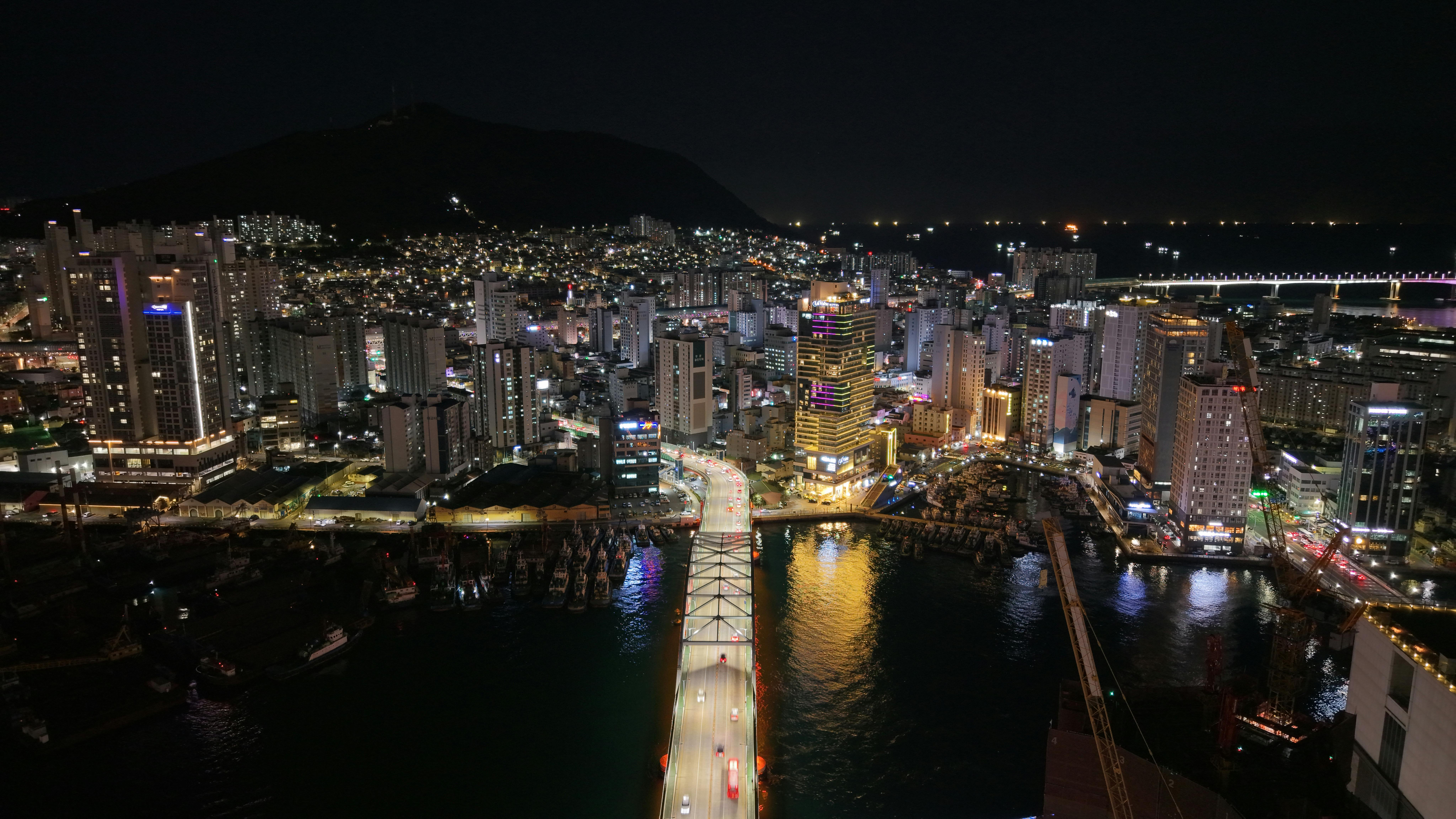
Busan is South Korea’s sea-facing counterpoint to Seoul: saltier, more sprawling, and emotionally looser around the edges. It is a city of beaches, fish markets, steep villages, suspension bridges, and harbor light, and it often becomes travelers’ surprise favorite because it feels both metropolitan and open to the horizon.
Historically, Busan has long been Korea’s gateway port, and its identity is inseparable from trade, displacement, and resilience. During the Korean War it served as a refuge when much of the peninsula was in chaos, and that sense of endurance still underlies the city’s practical, unsentimental energy.
Stay: Browse VRBO Busan or compare harbor and beach hotels on Hotels.com Busan. Haeundae is best for beach access and polished hotels; Nampo-dong suits market wandering and old-port atmosphere; Seomyeon works well if nightlife and transit convenience matter most.
Days 6-7: Markets, coastline and Busan’s maritime character
Start around Jagalchi Fish Market and BIFF Square, where Busan’s appetite announces itself immediately. Jagalchi is not merely a seafood market but a theatre of tanks, knives, bargaining, and astonishing variety; it is the best place to understand just how deeply the sea defines local cuisine.
Then move to Gamcheon Culture Village, the hillside neighborhood of painted houses and art installations. It can be busy, but it remains worth seeing because its layered terraces tell a social history as much as an aesthetic one, revealing how informal hillside communities evolved into one of Busan’s most recognizable urban landscapes.
- Breakfast & coffee: Seek out a specialty cafe near Jeonpo or Seomyeon before sightseeing. Busan’s cafe scene is excellent, and many spaces lean airy and design-forward, which suits a slower morning after the Seoul-Busan transfer.
- Lunch: Eat hoe (Korean sliced raw fish) or grilled seafood near Jagalchi, or choose dwaeji gukbap, Busan’s beloved pork soup with rice. The latter is especially worth recommending because it is hearty, local, and deeply tied to the city’s working-class roots.
- Dinner: In Haeundae, go for shellfish grills, sashimi, or milmyeon, Busan’s refreshing wheat noodles. If you prefer a more atmospheric evening, dine by Gwangalli Beach with Gwangan Bridge illuminated across the bay.
Cap one evening at Gwangalli Beach rather than Haeundae if you want a more memorable skyline tableau. The bridge lights, sea air, and line of restaurants and bars create one of Korea’s finest urban waterfront scenes.
Travel to Osaka: Fly Busan to Osaka (usually Kansai International Airport) using Trip.com flights or Kiwi.com flights. Nonstop flights are often around 1.5 hours, with typical fares roughly USD 50-150 before baggage, making this the most sensible cross-border hop.
Osaka
Osaka has the confidence of a city that knows pleasure is serious business. Japan’s great merchant metropolis is generous rather than ceremonious, famed for street food, extroverted neighborhoods, comedy, and a local identity that feels more direct and less formal than Kyoto or Tokyo.
It is also an excellent base. You can enjoy Osaka itself—the canals, castle, retro alleys, and food markets—while using its transport links for onward rail travel through western Japan.
Stay: Search VRBO Osaka or compare city hotels on Hotels.com Osaka. Namba is ideal for first-timers because Dotonbori, Kuromon Market, and many restaurants are walkable; Umeda is more polished and convenient for train connections.
Days 8-10: Osaka food districts, castle grounds and classic urban energy
Give Osaka at least one full day with no agenda beyond eating and wandering. Kuromon Market is useful for a grazing lunch of sea urchin, grilled scallops, tamagoyaki, fruit, and wagyu skewers, though the true pleasure comes later in Dotonbori and the side streets of Namba, where takoyaki, kushikatsu, ramen, and izakaya culture compete for your attention.
Osaka Castle is worth visiting less for the reconstructed interior than for the commanding grounds, moats, and historical symbolism. The current structure is modernized inside, but the site still conveys Toyotomi-era ambition and the strategic importance of Osaka in Japan’s unification story.
- Breakfast & coffee: Begin at a kissaten-style coffee shop or modern roastery in Namba or Shinsaibashi. Osaka mornings can be pleasantly understated before the entertainment districts wake up.
- Lunch: Sample okonomiyaki, the city’s savory griddled pancake layered with cabbage and toppings, or takoyaki from a long-running specialist. Osaka’s reputation as “Japan’s kitchen” is not branding fluff; its everyday food culture is among the nation’s most joyful.
- Dinner: Reserve an evening for kushikatsu in Shinsekai, where skewered meats and vegetables are battered and fried, then dipped—once only—in communal sauce. The retro neighborhood, with Tsutenkaku Tower looming above, feels like a surviving fragment of old popular Osaka.
Also make time for Nakazakicho, a quieter neighborhood of indie boutiques, old houses, and cafes that offers relief from Dotonbori’s sensory barrage. It is one of the best places to see Osaka’s softer, more local side.
Travel to Kyoto: Take a morning train via Trip.com trains. Osaka to Kyoto is usually 30-60 minutes depending on departure station and service, often around USD 5-15. Because the distance is short, you could also keep one Osaka base and day-trip, but a Kyoto stay offers a more atmospheric early morning and evening experience.
Kyoto
Kyoto is not simply “traditional Japan”; it is a city where ritual, aesthetics, and seasonal awareness still shape daily life in visible ways. The old imperial capital can be overcrowded in headline spots, but with careful timing it remains one of the most transporting urban experiences in the world.
The secret is to pair major monuments with neighborhood texture. For every famous shrine, make room for a small lane, a tea shop, a tofu lunch, a temple sub-garden, or an evening walk in Gion when the lantern light and wooden facades recover their old spell.
Stay: Browse VRBO Kyoto for machiya-style stays or apartments, and compare ryokan and hotels via Hotels.com Kyoto. Higashiyama is best for atmosphere; Downtown Kyoto is more practical for dining and transport.
Days 10-12: Temples, gardens, Gion and Kyoto after the day-trippers leave
Start early at Fushimi Inari Taisha, whose vermilion torii tunnels are famous for good reason. The best advice is not merely to arrive early, but to climb farther up the mountain than most visitors do; within 30-45 minutes the crowds thin and the shrine path becomes meditative rather than photographic.
Dedicate another half day to eastern Kyoto: Kiyomizu-dera, Sannenzaka, Ninenzaka, and Maruyama Park leading toward Gion. These preserved streets can be busy, but they still reward patient travelers with rooflines, stone steps, craft shops, and occasional glimpses of old Kyoto urban form.
- Breakfast & coffee: Choose a Kyoto roastery near Higashiyama or a traditional Japanese breakfast at a ryokan-style dining room. Kyoto mornings are at their best when quiet, so begin before 8 a.m. where possible.
- Lunch: Have yudofu near temple districts, soba in a long-running noodle shop, or obanzai, Kyoto’s style of homey small dishes focused on seasonality. These meals suit Kyoto because they express restraint and ingredients rather than excess.
- Dinner: Book a kaiseki experience if your budget allows, or enjoy grilled river fish, tofu cuisine, and sake in Pontocho. Pontocho’s narrow alley beside the Kamo River remains one of the city’s most evocative evening walks.
If you want a less crowded counterpoint, head to Arashiyama early for the bamboo grove, then continue into quieter temple gardens and river views. The grove itself is brief, but the wider district—especially when explored beyond the main path—contains much of the area’s real beauty.
Travel to Hiroshima: Take a morning Shinkansen using Trip.com trains. Kyoto to Hiroshima is generally about 1 hour 40 minutes to 2 hours depending on service, with fares commonly around USD 70-120.
Hiroshima
Hiroshima is one of the most affecting cities in Japan, not because it is frozen in tragedy, but because it so clearly chose life afterward. The city is leafy, easy to navigate, and full of humane urban spaces, yet its history gives every park, riverbank, and memorial a depth that most destinations cannot approach.
Beyond the Peace Memorial area, Hiroshima is also a fine food city and an excellent base for Miyajima if you wish to add a classic excursion. Even within a shorter stay, it offers one of the trip’s strongest emotional and historical climaxes.
Stay: Search VRBO Hiroshima or compare city-center hotels on Hotels.com Hiroshima. Staying near Hiroshima Station is efficient for rail users; staying nearer Peace Memorial Park gives a more walkable, contemplative base.
Days 12-14: Peace Memorial Park, local food and a memorable finale
Set aside unhurried time for the Hiroshima Peace Memorial Museum, Atomic Bomb Dome, and Peace Memorial Park. This is not a place to rush between photo points; the museum’s careful chronology and personal testimonies demand time, and the park itself is best absorbed slowly, crossing bridges and pausing at the cenotaph and Children’s Peace Monument.
For a contrasting day, consider Miyajima if schedules allow—especially Itsukushima Shrine and the island’s wooded slopes. If you prefer to stay in the city, explore Shukkeien Garden and then devote the evening to food, because Hiroshima’s okonomiyaki, layered with noodles and cooked in distinct strata, is proudly different from Osaka’s version.
- Breakfast & coffee: Find a calm specialty cafe near the center before heading to the memorial district. Hiroshima’s compact center makes it easy to enjoy a measured start.
- Lunch: Eat Hiroshima-style okonomiyaki at a specialist venue where you can watch it prepared on a hot plate. The visual layering—batter, cabbage, noodles, egg, sauce—makes the meal part performance, part local identity lesson.
- Dinner: Try oysters, especially in season, or seek out an izakaya serving anago conger eel and regional sake. Hiroshima Bay’s seafood culture deserves space beside the city’s more famous historical associations.
Departure options: For your onward international return, compare flights from nearby Kansai-area airports or Hiroshima-linked domestic connections using Trip.com flights or Kiwi.com flights. Another practical option is returning by Shinkansen toward Osaka/Kansai for a long-haul departure if fares are significantly better.
Optional pre-trip Adelaide add-ons
If you have extra time before the international departure from Adelaide, there are several worthwhile South Australia experiences available. For wildlife, the Kangaroo Island in a Day Tour from Adelaide is a strong choice for travelers wanting dramatic coastal scenery and native animals in one concentrated outing.

Wine lovers should look at the Discover Barossa: 4 Wine Tastings, Gourmet Lunch, and Hidden Gems, which pairs premium tastings with a polished regional overview. It works especially well as a contrasting prelude to the denser urban rhythm of Seoul and Japan.

If you prefer a shorter scenic outing, the Adelaide Hills and Hahndorf Half-Day Tour from Adelaide offers a pleasing introduction to the Adelaide Hills, village heritage, and a gentler pace before your long-haul flight.

For a water-based option, the 90 Minute Port Adelaide Dolphin & Ships Graveyard Cruise is a fun, compact excursion with a very different atmosphere from the wine-country circuit.

This 14-day Korea and Japan itinerary gives you five cities with distinctly different temperaments: royal Seoul, maritime Busan, exuberant Osaka, contemplative Kyoto, and resilient Hiroshima. It is a route built for travelers who want history, food, efficient rail travel, and enough neighborhood time to feel the places rather than merely count them.
Done well, this journey becomes more than a checklist of highlights. It becomes a moving study in how cities remember, reinvent, and feed the people who pass through them—and that is the sort of trip that lingers long after the flight home.