
The 9 Most Beautiful Small Towns in Thailand for a Slower, Richer Trip

Skip the obvious resorts. These nine small Thai towns trade crowds for misty mountains, riverfront wooden houses, and temples that feel genuinely lived-in.
Last updated June 22, 2026
The 9 Most Beautiful Small Towns in Thailand for a Slower, Richer Trip
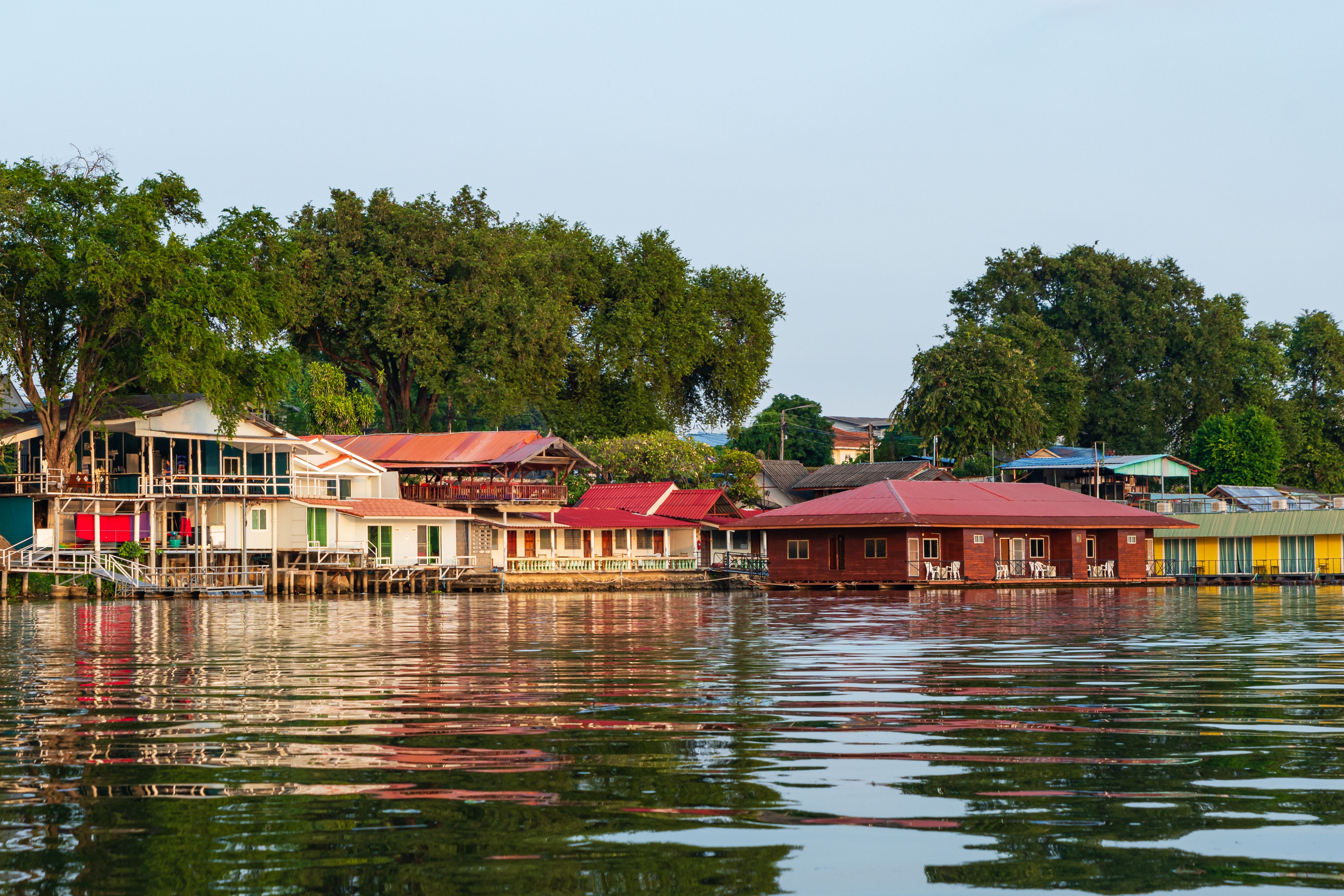
Scenic view of riverside houses in Kanchanaburi, Thailand, reflecting tranquil waters at sunset. · Kirandeep Singh Walia

Thailand's reputation rests on Bangkok's energy and the southern islands, but its quiet heart lives in the small towns: river settlements where monks still collect alms at dawn, teak-house neighborhoods that survived the cement boom, and valleys ringed by jungle hills. These are places where you can walk the whole center in an afternoon and still find something new the next morning.

This list ranges from the far north's mountain towns to a Mekong border town and a sleepy canal community an hour from Bangkok. Each was chosen for the way it looks and feels: architecture, setting, and atmosphere, not just a single famous sight.

Use it to build a slower itinerary. Most of these pair naturally with a bigger hub (Chiang Mai, Bangkok, or a flight to a regional airport), and several are worth at least an overnight to catch the morning markets and quiet evenings that make them special.

1
Pai
PaiMae Hong Son province, about 3 hours northwest of Chiang Mai Google
Pai sits in a green river valley reached by a famously winding road with 762 curves, and that journey is part of the appeal. The walking-street center is a cluster of wooden shophouses, cafes, and night-market stalls that fills with travelers after dark but empties into birdsong by morning. Spend your days on a scooter loop to the Pai Canyon ridgelines, the Tha Pai hot springs, and the Mo Paeng waterfall, then watch the sun drop over the rice paddies from a riverside bar. It is bohemian and a little touristy, but the setting is genuinely gorgeous, especially in the cool, misty mornings of December and January.
  • Sunrise over the valley from Yun Lai viewpoint
  • Pai Canyon's narrow red-earth ridges at sunset
  • The wooden bamboo bridge (Boon Ko Ku So) through the paddies
  • Walking Street night market food
Best for: young travelers, scooter explorers, and slow mountain days
Getting there: About 3 hours by minivan or car from Chiang Mai on the mountain road; a small airport also has occasional flights
2
Chiang Khan
Chiang KhanLoei province, on the Mekong River in the northeast Google
Chiang Khan is a single long lane of century-old teak shophouses running parallel to the Mekong, with Laos visible on the far bank. At dawn, lines of monks walk the old street to receive sticky rice from kneeling locals, one of the most authentic alms-giving scenes left in Thailand. By evening the Chai Khong walking street wakes up with northeastern snacks, handmade crafts, and riverside guesthouses whose balconies hang right over the water. It is unpretentious and deeply photogenic, best in the cool season when river mist rises off the Mekong at sunrise.
  • Dawn alms-giving on the old wooden street
  • Sunrise over the Mekong from Phu Thok hill
  • Chai Khong walking street at night
  • Kaeng Khut Khu rapids just downstream
Best for: photographers, couples, and a peaceful riverside overnight
Getting there: Fly Bangkok to Loei (about 1 hour), then 45 minutes by taxi; or an overnight bus from Bangkok
3
Nan
NanNan province, far northern Thailand near the Laos border Google
Tucked in a remote valley that long kept it off the tourist trail, Nan is a small town with an outsized cultural richness. Its star is Wat Phumin, a 16th-century temple whose interior murals include the famous 'whispering' couple, an image so beloved it appears on local everything. The riverside old town is flat and bikeable, dotted with cafes and the excellent Nan National Museum, and the surrounding hills hide Doi Phu Kha National Park and terraced farmland. Come for the slow pace, the cool-season festivals, and the sense of a place that still belongs mostly to itself.
  • The whispering-couple murals at Wat Phumin
  • Wat Phra That Chae Haeng's golden chedi
  • Cycling the riverside old town
  • Day trip to Bo Kluea salt wells and Doi Phu Kha
Best for: culture lovers and travelers seeking somewhere genuinely quiet
Getting there: Direct flights from Bangkok to Nan (about 1 hour 20 minutes); or a long bus from Chiang Mai
4
Mae Hong Son
Mae Hong SonMae Hong Son province, deep in the northwestern mountains Google
Ringed by forested peaks near the Myanmar border, Mae Hong Son is a Shan-influenced town built around a small lake reflecting two Burmese-style temples. The morning market is one of the north's best, full of Shan and hill-tribe vendors, fermented teas, and dishes you will not find further south. Climb to Wat Phra That Doi Kong Mu at dusk for a view over the valley, often draped in the morning fog that gives the province its nickname, the City of Three Mists. It is the kind of town where the surrounding mountains, waterfalls, and villages are as much the draw as the center itself.
  • Wat Chong Kham and Wat Chong Klang glowing over Nong Jong Kham lake
  • Sunset at Wat Phra That Doi Kong Mu
  • The lively morning market
  • Pha Sua waterfall and nearby Shan villages
Best for: mountain scenery, slow travel, and northern food
Getting there: Short flights from Chiang Mai, or the long but scenic loop road via Pai
5
Lampang
LampangLampang province, about 1.5 hours south of Chiang Mai Google
Often skipped on the rush between Chiang Mai and Sukhothai, Lampang rewards anyone who stops with horse-drawn carriages clopping past riverside teak mansions and one of Thailand's finest wooden temples. The Talat Gao old quarter mixes Burmese, Chinese, and Lanna shophouses, many now turned into low-key cafes and galleries. Just outside town, Wat Phra That Lampang Luang is a fortress-like teak temple complex considered among the most beautiful in the country. The pace is slow, the crowds thin, and the architecture genuinely special.
  • Wat Phra That Lampang Luang's ancient teak halls
  • A horse-carriage ride through the old town
  • Wat Sri Chum's Burmese woodwork
  • Cafes and antique shops along Talat Gao
Best for: architecture fans and an easy detour from Chiang Mai
Getting there: About 1.5 hours by train, bus, or car from Chiang Mai; trains continue from Bangkok
6
Amphawa
AmphawaSamut Songkhram province, about 1.5 hours southwest of Bangkok Google
Amphawa is the most atmospheric of the canal towns near Bangkok, centered on a working waterway lined with old wooden houses, cafes, and a weekend floating market that comes alive in the late afternoon. Vendors grill prawns and squid from boats while you eat on the canal steps, and after dark long-tail boats glide out to watch fireflies blink in the riverside trees. Unlike the daytime tourist markets, Amphawa keeps a local, evening rhythm and is easy to do as an overnight in a canalside guesthouse. Nearby Wat Bang Kung, with its temple wrapped entirely in the roots of a banyan tree, makes a memorable side trip.
  • Evening floating market with grilled-from-the-boat seafood
  • Firefly boat tours after dark
  • The root-wrapped chapel at Wat Bang Kung
  • Maeklong railway market nearby
Best for: a weekend escape from Bangkok and food lovers
Getting there: About 1.5 hours by car or minivan from Bangkok; best visited Friday to Sunday when the market runs
7
Sangkhlaburi
SangkhlaburiKanchanaburi province, near the Myanmar border in the west Google
Remote Sangkhlaburi sits beside a vast reservoir spanned by Thailand's longest hand-built wooden footbridge, the Mon Bridge, which connects the Thai town to a Mon community on the far side. Mornings here are extraordinary: monks cross the bridge for alms as mist lifts off the water, and during the dry season the spire of a submerged temple emerges from the lake. The Mon culture, the markets, and the surrounding jungle hills give it a frontier feel quite unlike anywhere else in the country. It takes effort to reach, which is exactly why it stays so unspoiled.
  • Crossing the wooden Mon Bridge at sunrise
  • The sunken temple of Wat Wang Wiwekaram
  • Mon morning market and traditional dress
  • Boat trips on the reservoir
Best for: adventurous travelers and anyone wanting somewhere truly off-grid
Getting there: About 5 to 6 hours by car or bus from Bangkok via Kanchanaburi; the final stretch is a winding mountain road
8
Sukhothai (Old Town)
Sukhothai (Old Town)Sukhothai province, central-northern Thailand Google
4.7 · 18,159 reviews
The town beside the ruins of Thailand's first capital is small and sleepy, and that quiet is part of why exploring the Sukhothai Historical Park is so magical. Rent a bicycle and roll between 13th-century chedis, serene seated Buddhas, and lotus-filled ponds across a UNESCO World Heritage parkland that is far calmer than Ayutthaya. The standout image is the great seated Buddha of Wat Si Chum framed in a narrow brick wall, and the park glows at golden hour when day-trippers have left. Stay in Old Sukhothai rather than the modern new town to be steps from the gates.
  • Cycling the Historical Park at sunrise
  • The towering Buddha of Wat Si Chum
  • Wat Mahathat's lotus-bud chedi
  • Si Satchanalai ruins nearby with even fewer visitors
Best for: history lovers and peaceful cycling
Getting there: Direct flights from Bangkok to Sukhothai, or about 7 hours by bus; the airport is a short ride from the old town
9
Phrae
PhraePhrae province, northern Thailand between Lampang and Nan Google
Phrae is one of the last northern towns still defined by old teak architecture, with a walled old quarter of wooden temples and the grand Vongburi House, a pink colonial-era teak mansion open to visitors. Almost untouched by mass tourism, it is a place to wander quiet lanes, sample northern Thai food without a queue, and visit the dramatic eroded cliffs of Phae Mueang Phi just outside town. The town's distinctive mor hom indigo cotton is woven and dyed locally and makes a far better souvenir than anything in a tourist market. It works perfectly as a stop between Lampang and Nan.
  • The teak Vongburi House museum
  • Wat Phra That Cho Hae on its hilltop
  • The eroded earth pillars of Phae Mueang Phi
  • Locally woven mor hom indigo cloth
Best for: travelers chasing authentic, crowd-free northern towns
Getting there: Short flights from Bangkok to Phrae, or by bus and car along the route linking Lampang and Nan

Good to Know

When to go The cool, dry season from November to February is the most beautiful time for these towns, especially the northern and Mekong spots where morning mist is part of the magic. Avoid March and April when burning season smoke can blanket the north.
Getting around Renting a scooter is the easiest way to explore small-town surroundings, but only ride one if you are confident and licensed; otherwise local songthaews and grab cars work in most towns. For longer hops, domestic flights to Nan, Loei, Sukhothai, and Mae Hong Son save many hours over buses.
Stay overnight Most of these towns reveal their best at dawn (alms-giving, markets, river mist), so resist day-tripping where you can and book a riverside or old-town guesthouse for at least one night.
Book ahead in high season During the December to January peak and Thai holidays, the best canalside and riverfront rooms in Chiang Khan, Pai, and Amphawa sell out early, so reserve a few weeks in advance.

Thailand's small towns reward the traveler who slows down: a dawn walk along the Mekong, a bicycle ride through ancient ruins, an evening of grilled prawns beside a canal. String two or three of these together with a regional flight or a scenic drive, and you will come home with a very different, quieter picture of the country. Start by picking one north and one near Bangkok, and build your trip around their morning markets.

Ready to book your trip?

Search Hotels
Search Homes

Traveling somewhere else?

Generate a custom itinerary