
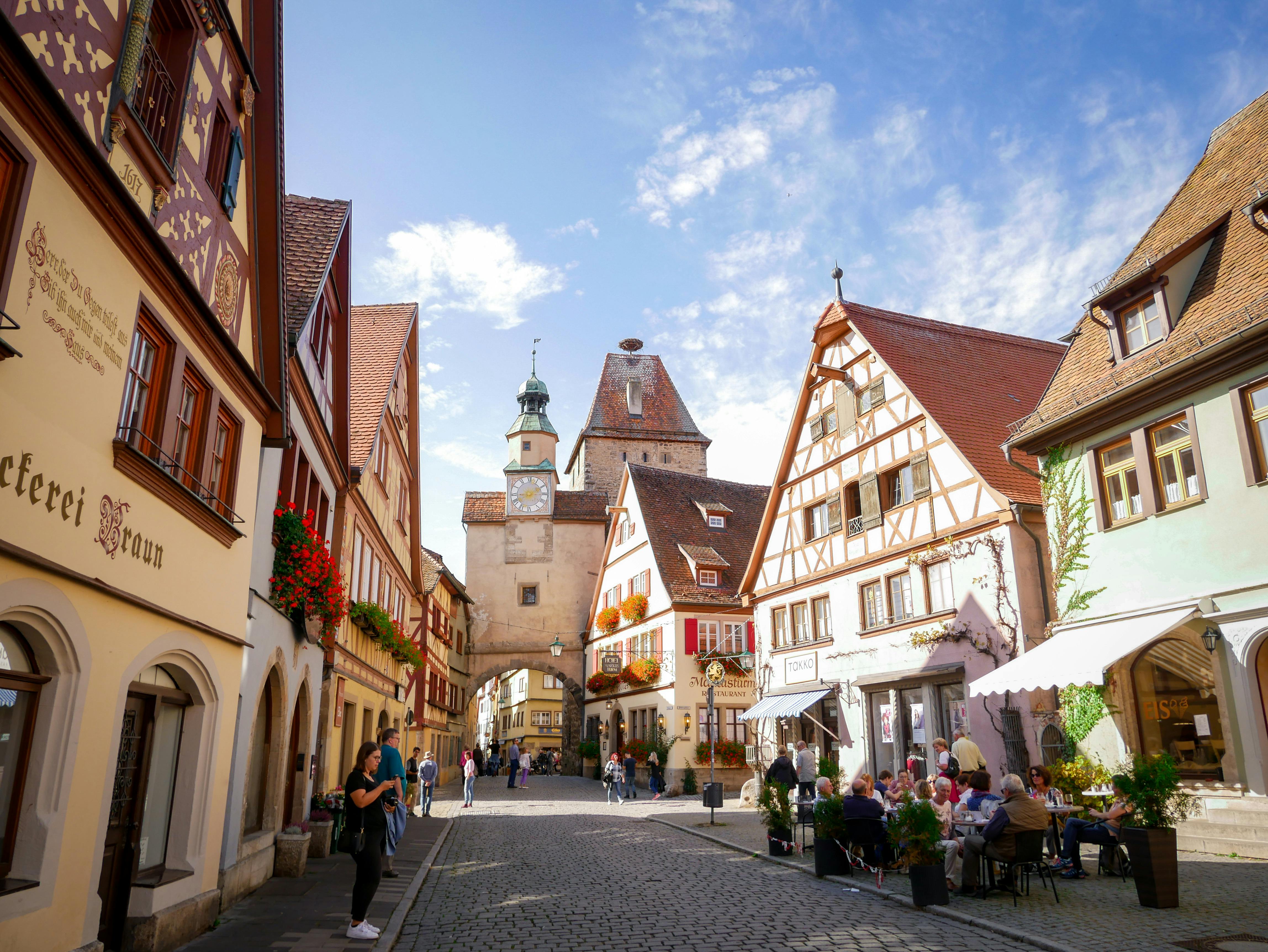
Picturesque cobblestone street in Rothenburg ob der Tauber showcasing traditional German architecture.
List · Germany 9 picks

The 9 Most Beautiful Small Towns in Germany

From half-timbered fairytale lanes to Rhine and Moselle wine villages, these are the German small towns worth crossing the country for.

Last updated June 30, 202611 min read
Top pick

Rothenburg ob der Tauber is the best all-rounder and the most complete medieval townscape; choose Bamberg for food, beer and UNESCO grandeur, or Bacharach if you want a quiet Rhine wine village with castle views.

Germany does small towns better than almost anywhere: cobbled market squares ringed by leaning half-timbered houses, hilltop castles, and church spires that have looked the same for five centuries. Many escaped the bombing that flattened larger cities, so what you walk through is the real medieval and Renaissance fabric, not a reconstruction.

This list spans the country, from the Bavarian Romantic Road to the wine villages of the Rhine and Moselle, the Harz mountains, and the shores of Lake Constance. Each town is genuinely walkable in a day, photogenic in every direction, and backed by a concrete reason to go beyond the postcard.

Use the comparison details to plan: most of these are reachable by train from a nearby hub city, and several pair naturally into a two- or three-stop road trip. Pick by region and vibe, then read the entry for what to actually see and eat.

Rothenburg ob der Tauber1tours from $98.63
Rothenburg ob der Tauber Google
Northern Bavaria, on the Romantic Road, about 1.5 hours west of Nuremberg
This is the picture most people have in their heads when they imagine a German fairytale town: a fully intact medieval wall you can walk along, crooked half-timbered houses, and the famous Plonlein corner where two lanes meet beneath a tower. It survived the centuries because it fell into poverty and irrelevance, freezing its 17th-century shape in place. Come early or stay overnight to have the lanes to yourself after the day-trip coaches leave, and don't miss the night watchman's tour, a genuinely entertaining hour of history and dark humor. Year-round, the Kathe Wohlfahrt Christmas shop keeps it feeling like December even in July.
  • Walk the covered medieval town wall
  • The Plonlein, Germany's most photographed corner
  • The Night Watchman's guided evening tour
  • Schneeballen pastry dusted in sugar
Best for first-time visitors and photographers
Getting there By train from Nuremberg in about 1.5 hours via Steinach; many day tours run from Munich along the Romantic Road
Bamberg2
Bamberg Google
Upper Franconia, Bavaria, about 40 minutes north of Nuremberg
Bamberg spreads across seven hills and a river island, and its entire old town is a UNESCO World Heritage Site that came through World War II almost untouched. The half-timbered old town hall sits dramatically on a tiny island mid-river, painted with trompe l'oeil frescoes, while the four-towered Romanesque cathedral crowns the hill above. Bamberg is also a beer town with its own smoked specialty: order a Rauchbier at Schlenkerla, where the malt is dried over beechwood for a flavor like bacon in a glass. It is lively without feeling touristy, thanks to a large student population.
  • The Altes Rathaus on its river island
  • Bamberg Cathedral and the mysterious Bamberg Horseman statue
  • Smoked Rauchbier at Schlenkerla
  • Little Venice, the old fishermen's cottages along the river
Best for food and beer lovers
Getting there By train from Nuremberg in about 40 minutes, or roughly 2 hours from Munich
Quedlinburg3
Quedlinburg Google
Saxony-Anhalt, at the edge of the Harz mountains
Quedlinburg has more than 1,300 half-timbered houses spanning six centuries, one of the densest concentrations of timber-framing in Europe and the reason the whole town is UNESCO-listed. The cobbled lanes climb to a sandstone castle hill topped by the Romanesque collegiate church of St. Servatius, where Germany's first king was buried. It feels refreshingly local and uncommercial compared with the Bavarian heavyweights, with artists' studios and small cafes filling the crooked old buildings. Use it as a base for the Harz, including the narrow-gauge steam railway up the Brocken.
  • The castle hill and St. Servatius collegiate church
  • Marktplatz and the Renaissance town hall
  • Hundreds of timber-framed houses on Finkenherd and Word lanes
  • Day trip on the Harz steam railway
Best for history buffs and quieter exploring
Getting there By train from Magdeburg in about 1 hour 20 minutes, or roughly 3.5 hours from Berlin with a change
Bacharach4
Bacharach Google
Rhine Valley, Rhineland-Palatinate, about 50 minutes south of Koblenz
Bacharach is the quintessential Rhine wine village, a tumble of half-timbered houses and crumbling town walls in the heart of the UNESCO-listed Upper Middle Rhine Valley. Above town sits Burg Stahleck, a 12th-century castle now run as a youth hostel with one of the best river views in Germany. The surrounding hills produce excellent Riesling, and you can taste it in tiny straussen wine taverns or beside the river. From here you are perfectly placed to take a Rhine boat cruise past the Lorelei rock and a procession of clifftop castles.
  • Burg Stahleck castle and its Rhine viewpoint
  • Riesling tasting in local wine taverns
  • The ruined Wernerkapelle Gothic chapel
  • KD Rhine boat cruise toward the Lorelei
Best for wine lovers and romantic riverside stays
Getting there By regional train along the Rhine from Koblenz in about 50 minutes, or from Mainz in about 45 minutes
Cochem5
Cochem Google
Moselle Valley, Rhineland-Palatinate, about 50 minutes from Koblenz
Cochem curls along a bend of the Moselle beneath the Reichsburg, a hilltop castle rebuilt in dramatic neo-Gothic style and floodlit at night. The old town is a maze of pastel half-timbered houses, market squares, and wine taverns, with vineyards rising steeply straight from the riverbank. Ride the Sesselbahn chairlift up to the Pinnerkreuz for a sweeping view over the river loop, then come back down for a glass of crisp Moselle Riesling. It is one of the prettiest river towns in the country and an easy, relaxed overnight.
  • Reichsburg castle above the river
  • Sesselbahn chairlift to the Pinnerkreuz viewpoint
  • Moselle Riesling in the old town wine taverns
  • Riverside promenade and Marktplatz
Best for a relaxed riverside overnight
Getting there By train from Koblenz in about 50 minutes; Frankfurt is roughly 2 hours away by car
Monschau6
Monschau Google
Eifel region, North Rhine-Westphalia, near the Belgian border
Tucked into a narrow gorge in the Eifel hills, Monschau is a cluster of black-and-white timbered houses pressed along the Rur river, with slate roofs and a ruined castle on the ridge above. The town grew rich on cloth-making, and its centerpiece is the Rotes Haus, a grand 18th-century merchant's mansion you can tour. Narrow lanes, footbridges, and a mustard mill that still grinds the local specialty make it feel like a town that time forgot. It is especially atmospheric in autumn fog or under Christmas-market lights.
  • The Rotes Haus merchant's mansion and its carved staircase
  • Monschau Senfmuhle mustard mill and shop
  • The ruined Monschau castle viewpoint
  • Half-timbered lanes along the Rur river
Best for off-the-beaten-path day trips
Getting there About 1.5 hours by car from Cologne or Aachen; reachable by bus from Aachen in roughly 1 hour
Meersburg7
Meersburg Google
Lake Constance (Bodensee), Baden-Wurttemberg, in the far south
Meersburg climbs a vineyard slope above Lake Constance, with the Alps glittering across the water on a clear day. It is home to the Alte Burg, often cited as Germany's oldest inhabited castle, plus a grand Baroque Neues Schloss with terraced gardens overlooking the lake. The upper and lower towns are linked by stepped lanes lined with wine taverns pouring local Spatburgunder and Muller-Thurgau. Arrive by ferry across the lake for the best first view, and pair it with a swim or a vineyard walk in summer.
  • The Alte Burg medieval castle
  • Baroque Neues Schloss and terrace gardens
  • Lakeside wine taverns with Alpine views
  • Car ferry across Lake Constance from Konstanz
Best for summer lake trips and wine
Getting there By ferry from Konstanz in about 30 minutes, or by train to Friedrichshafen then bus/ferry
Fussen8tours from $91.67
Fussen Google
Bavarian Alps, on the Romantic Road, about 2 hours southwest of Munich
Fussen is the colorful Alpine town at the foot of the mountains, best known as the gateway to Neuschwanstein and Hohenschwangau castles just a few minutes away. But the town itself rewards a wander: a pastel old town, the High Castle (Hohes Schloss) with its painted illusionist facades, and the Baroque St. Mang Basilica beside the river. Lakes Forggensee and Alpsee offer boat trips and swimming, and the setting against the Tannheim peaks is spectacular. Stay overnight to see the castles early before the day crowds arrive.
  • Neuschwanstein and Hohenschwangau castles nearby
  • The Hohes Schloss and its painted facades
  • St. Mang Basilica and old town lanes
  • Boat trip on the Forggensee or Alpsee
Best for castle lovers and Alpine scenery
Getting there By direct train from Munich in about 2 hours; many small-group day tours run from Munich
Gorlitz9
Gorlitz Google
Saxony, on the Polish border, about 1.5 hours east of Dresden
Germany's easternmost town survived the war almost completely intact, leaving more than 4,000 protected buildings spanning Gothic, Renaissance, Baroque, and Art Nouveau styles. That cinematic, untouched streetscape has made it a favorite film location, standing in for other cities in movies like The Grand Budapest Hotel and Inglourious Basterds, earning it the nickname Gorliwood. Cross the footbridge over the Neisse river and you are in Poland, so lunch in two countries is easy. It feels grand and slightly dreamlike, with far fewer tourists than it deserves.
  • The Renaissance Untermarkt square and ornate merchant houses
  • Film locations from The Grand Budapest Hotel
  • The Holy Sepulchre complex
  • Walk across the river into Zgorzelec, Poland
Best for architecture fans and film buffs
Getting there By train from Dresden in about 1.5 hours

Want these spots worked into your trip?

We'll build a custom Germany itinerary around the places you pick.

Generate itinerary
Good to know

Before you go

Getting aroundMost of these towns are reachable by regional train, but a rental car unlocks the Romantic Road, the Moselle, and the Eifel where rail service thins out. Town centers are compact and best explored on foot.
When to goLate spring and early autumn bring the best mix of mild weather and thinner crowds. December transforms Rothenburg, Bamberg, and Monschau into storybook Christmas markets, but expect cold and busy weekends.
Stay overnightDay-trip coaches dominate the famous towns from late morning to mid-afternoon. Staying a night gives you the lanes nearly to yourself at dawn and dusk, which is when they photograph best.
Pair them upBacharach and Cochem combine into a Rhine-and-Moselle wine trip from Koblenz, while Rothenburg and Fussen bookend the Romantic Road. Quedlinburg and Goslar make a neat Harz pairing.

Germany's small towns reward slowing down: a glass of Riesling on a Moselle terrace, a night watchman's lantern in Rothenburg, fog settling over Monschau's slate roofs. Pick one region, link two or three towns into an easy route, and give yourself at least one overnight to see these places at their quiet, golden best. Whichever you choose, the half-timbered Germany of the imagination is still very much standing.

Frequently asked questions

Which is the most beautiful small town in Germany?
Rothenburg ob der Tauber is the most frequently named, thanks to its fully intact medieval wall, half-timbered houses, and the famous Plonlein corner. Bamberg and Quedlinburg are close rivals, with Bamberg offering more food and beer and Quedlinburg feeling quieter and more local.
Which German small town is best for a day trip?
Rothenburg ob der Tauber and Fussen are both easy day trips from Munich, while Bacharach and Cochem work well from Koblenz or Mainz. Bamberg is a simple 40-minute train ride from Nuremberg.
What is the prettiest town on the Romantic Road?
Rothenburg ob der Tauber is the standout, with Dinkelsbuhl and Fussen also worth a stop. Rothenburg has the best-preserved medieval wall and old town along the route.
Which small towns in Germany are good for wine?
Bacharach on the Rhine and Cochem on the Moselle are both surrounded by steep Riesling vineyards with tasting taverns in town. Meersburg on Lake Constance pours local Spatburgunder and Muller-Thurgau with Alpine views.
Are these towns walkable without a car?
Yes, the historic centers are all compact and pedestrian-friendly. Reaching them is easiest by train for Bamberg, Quedlinburg, Cochem, Bacharach, Fussen, and Gorlitz, while Monschau and parts of the Romantic Road are simpler with a car or organized tour.
Plan with MagicTrips

Build your own Germany trip

Tell us how many days, your budget, and what you're into. We'll turn it into a custom, day-by-day Germany itinerary.

Ready to book your stay?

Hotels
Homes

Traveling somewhere else?

Generate a custom itinerary