
The 9 Most Beautiful Small Towns in Bulgaria

From cobbled Revival-era towns in the mountains to ancient stone churches above the Black Sea, these are the Bulgarian towns worth building a road trip around.
Last updated June 22, 2026
The 9 Most Beautiful Small Towns in Bulgaria
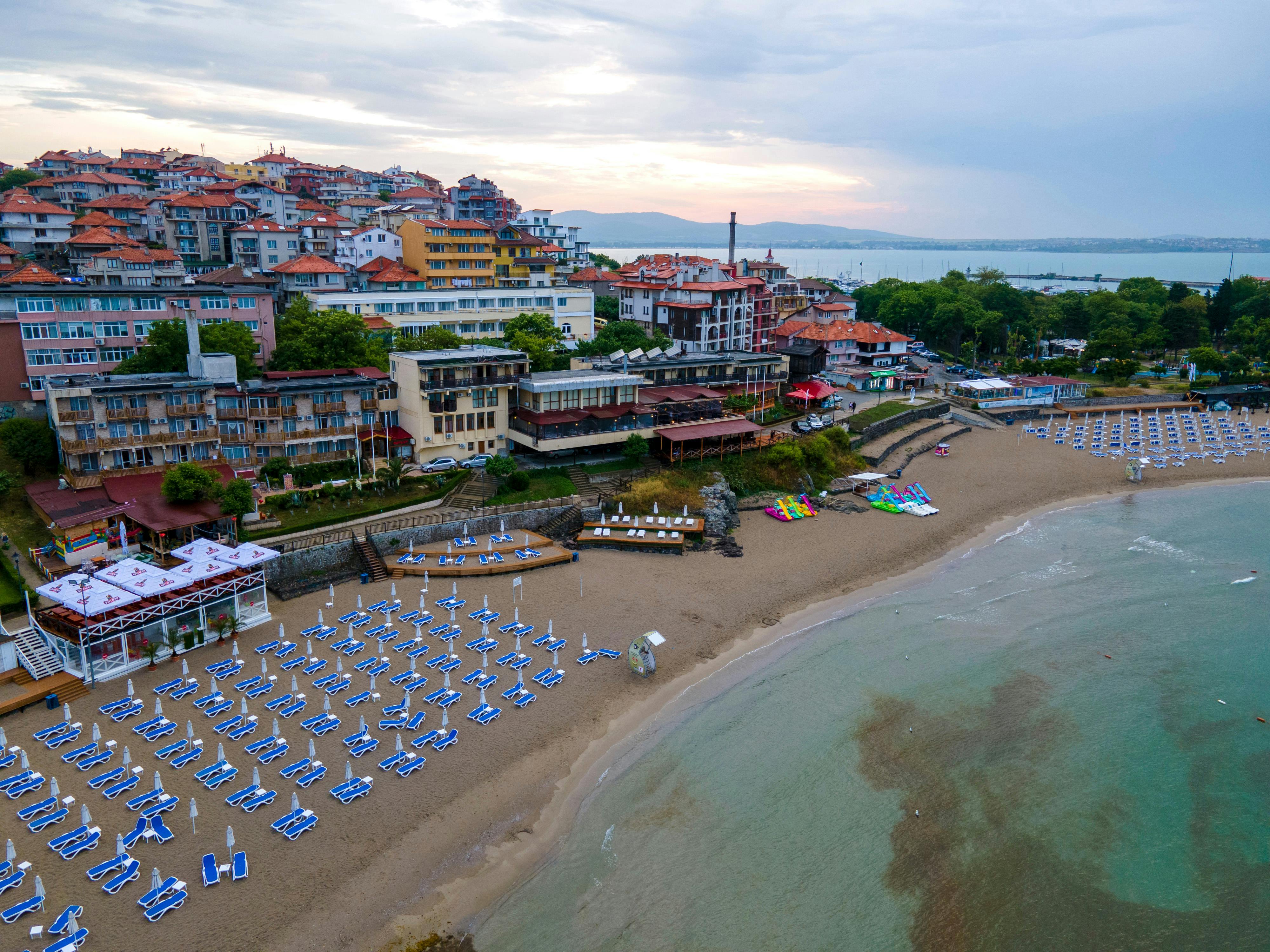
Aerial view of Sozopol's beach with sunbeds, buildings, and coastal scenery in Bulgaria. · Denitsa Kireva

Bulgaria packs an outsized amount of beauty into its small towns. The country's 19th-century National Revival left behind clusters of timber-framed houses with bay windows and carved ceilings, while the Black Sea coast and the Rhodope and Pirin mountains hide stone villages, ancient churches, and vineyards that have barely changed in centuries.

These places reward slow travel. Many are walkable in an afternoon but deserve an overnight, when the day-trippers leave and the cobbled lanes go quiet. Several pair naturally into a single trip: the mountain Revival towns cluster within a few hours of Sofia and Plovdiv, while the coastal old towns string along the southern shore near Burgas.

Below are nine of the most beautiful, ranked roughly by how complete and memorable the experience is, with how to reach each from the nearest hub and who each one suits best. Mix a couple of coastal towns with a couple of mountain ones and you have the makings of a perfect Bulgarian loop.

1
Koprivshtitsa
KoprivshtitsaAbout 1.5 hours east of Sofia, in the Sredna Gora mountains Google
Koprivshtitsa is the postcard of Bulgarian National Revival architecture: nearly 400 protected buildings line cobbled lanes along a mountain stream, their facades painted ochre, blue, and dusky red, with overhanging upper floors and flower-filled courtyards. The town was the spark of the 1876 April Uprising against Ottoman rule, and that history is written into its house-museums, six of which you can tour with a single ticket. It feels frozen in the 1800s yet lived-in, with kafenes serving thick coffee and homemade rakia. Come for the architecture and stay for the mountain air and the sense of a whole town preserved intact.
  • The Oslekov House and its carved ceilings
  • The six house-museums combination ticket
  • Humpbacked stone bridges over the Topolnitsa
  • Local banitsa and yogurt at a village kafene
Best for: history lovers and architecture fans
Getting there: About 1.5 hours by car or direct bus from Sofia; the train station sits 9km below town with a connecting shuttle.
2
Nessebar
NessebarBlack Sea coast, about 35km north of Burgas Google
The old town of Nessebar sits on a rocky peninsula tied to the mainland by a narrow isthmus, and it is so dense with history that the whole core is a UNESCO World Heritage Site. Wander past the ruins of medieval Byzantine churches, their walls patterned in red brick and pale stone, between rows of dark-timbered fishermen's houses leaning over the lanes. The setting, with the sea on three sides and wooden windmills at the entrance, is genuinely cinematic. Go early or stay overnight, because the summer crowds from nearby Sunny Beach thin out by evening.
  • Church of Christ Pantocrator and St. Stephen's
  • The wooden windmill at the town entrance
  • Sea-view fish taverns on the rocks
  • 19th-century timber merchant houses
Best for: a coastal overnight with history
Getting there: About 40 minutes by bus or car from Burgas; frequent summer buses from Sunny Beach.
3
Melnik
MelnikPirin region, far southwest, about 2.5 hours from Sofia Google
Bulgaria's smallest official town, Melnik has a few hundred residents and a setting that stops you in your tracks: white-and-timber houses tucked beneath towering sandstone pyramids that glow gold at sunset. It is famous for its full-bodied red wine, traditionally aged in cellars dug straight into the rock, and you can taste it in family-run mehanas along the single main street. Hike up to the ruined Despot Slav fortress for views over the eroded badlands, or walk 40 minutes to the Rozhen Monastery. It is remote enough to feel like a discovery and beautiful enough to justify the drive.
  • Local Melnik red wine tasted in rock cellars
  • The Kordopulov House, a grand Revival mansion
  • Sandstone pyramid rock formations at sunset
  • Rozhen Monastery nearby
Best for: wine lovers and slow travelers
Getting there: About 2.5 hours by car from Sofia; buses run via Sandanski, where you change for a local connection.
4
Sozopol
SozopolBlack Sea coast, about 35km south of Burgas Google
Sozopol is Nessebar's quieter, more bohemian cousin, an ancient Greek foundation (then called Apollonia) whose old town crowds a small peninsula with wooden houses, fig trees, and tiny stone churches. The lanes tumble down to rocky swimming coves and a working harbor, and the town has long drawn Bulgarian artists and writers, giving it a relaxed, creative feel. Come in early September for the Apollonia Festival of Arts, or just settle into a clifftop taverna for grilled fish and a glass of white. It balances beach and culture better than almost anywhere on the coast.
  • The old town's timber houses and narrow lanes
  • Swimming off the rocks below the ramparts
  • Fresh-grilled Black Sea fish at harbor tavernas
  • The Apollonia arts festival in September
Best for: beach plus old-town atmosphere
Getting there: About 45 minutes by bus or car south from Burgas; regular summer minibuses.
5
Tryavna
TryavnaCentral Balkan mountains, about 1 hour south of Veliko Tarnovo Google
Tryavna is a master class in Revival woodcarving, and its compact old quarter feels like a stage set: a cobbled square with a clock tower, an arched stone bridge, and the oldest civic building in Bulgaria still standing. The town's carvers were renowned across the country, and you can see their ceilings and iconostases in the School of Woodcarving and the local churches. It is smaller and far less touristy than nearby Veliko Tarnovo, which is part of the charm. The surrounding wooded hills make it a fine base for an easy mountain walk.
  • The Daskalov House and its sun-carved ceilings
  • The 19th-century clock tower on the main square
  • The humpbacked stone bridge
  • Traditional woodcarving workshops
Best for: craft and architecture enthusiasts
Getting there: About 1 hour by car or train from Veliko Tarnovo; about 3.5 hours from Sofia.
6
Zheravna
ZheravnaEastern Balkan range, about 1.5 hours west of Burgas Google
Zheravna is an entire village of dark, weathered timber houses, more than 200 of them, set on a green mountain slope with no modern buildings to break the spell. Many homes are 200 to 300 years old, their wooden balconies and shingle roofs blackened with age, and grass grows between the cobbles of the unpaved lanes. It is genuinely atmospheric, especially in the morning mist or when the annual folk-costume festival fills the streets with traditional dress. Few places in Bulgaria feel this authentically untouched.
  • Centuries-old all-timber houses
  • The birthplace-museum of writer Yordan Yovkov
  • The summer National Festival of Folklore Costume
  • Unpaved lanes with mountain views
Best for: photographers and authenticity seekers
Getting there: About 1.5 hours by car from Burgas or Sliven; easiest with your own vehicle as public transport is limited.
7
Kovachevitsa
KovachevitsaWestern Rhodope mountains, about 2.5 hours from Sofia Google
Hidden high in the Rhodope mountains near the end of a winding road, Kovachevitsa is a village of tall stone houses with heavy slate roofs, built without much mortar and seemingly growing out of the hillside. Its remoteness has preserved it almost perfectly, and the lack of crowds gives it a still, timeless quality that has made it a favorite film location. There is little to do beyond walk the steep lanes, drink coffee on a stone terrace, and take in the forested views, which is exactly the appeal. It pairs well with the nearby village of Leshten.
  • Towering dry-stone houses with slate roofs
  • Quiet lanes and panoramic mountain terraces
  • Nearby Leshten village
  • Home-cooked Rhodope dishes in guesthouses
Best for: a quiet mountain retreat
Getting there: About 2.5 hours by car from Sofia via Gotse Delchev; a car is essential for the final mountain road.
8
Shiroka Laka
Shiroka LakaCentral Rhodope mountains, about 25km from Smolyan Google
Strung along a river valley deep in the Rhodopes, Shiroka Laka is known for two things: its handsome white Revival houses with dark timber trim, and its tradition of bagpipe music taught at the village's famous folk-music school. The Church of the Assumption, built in just 38 days in 1834, anchors the old center, and the whole village is an architectural reserve. Winter brings the eerie Kukeri festival, when masked dancers in shaggy costumes parade to chase off evil spirits. It is a soulful introduction to Rhodope mountain culture.
  • The 1834 Church of the Assumption
  • Traditional bagpipe (gaida) folk-music school
  • The March Kukeri masked festival
  • Stone bridges over the river
Best for: folk culture and mountain scenery
Getting there: About 30 minutes by car or local bus from Smolyan; roughly 3.5 hours from Plovdiv.
9
Bozhentsi
BozhentsiCentral Balkan range, about 15km from Gabrovo Google
Bozhentsi is a museum-village preserved as an architectural reserve, a cluster of stone-roofed Revival houses set among orchards and walnut trees in the hills near Gabrovo. There are no through roads or modern intrusions, just cobbled paths, low stone walls, and houses with carved wooden gates, several open to visitors as period homes. It is small and serene, ideal for an unhurried half-day of wandering and a long lunch of regional specialties. The setting feels like a storybook version of old rural Bulgaria.
  • Preserved Revival house-museums
  • Stone-slab roofs and carved wooden gates
  • Walnut-tree orchards and quiet lanes
  • Regional cooking in village taverns
Best for: a peaceful half-day stop
Getting there: About 25 minutes by car from Gabrovo; combine with Tryavna or Veliko Tarnovo by car.

Good to Know

Getting around A rental car transforms a Bulgarian small-town trip; many of the prettiest villages (Zheravna, Kovachevitsa, Bozhentsi) have sparse or no public transport. Coastal and major Revival towns are reachable by bus, but mountain villages are not.
When to go Late May to June and September are ideal: warm, green, and uncrowded. July and August bring heat and crowds to the Black Sea towns, while mountain villages stay cooler and quieter.
Pace yourself Group towns by region rather than crisscrossing the country. The Balkan Revival towns (Tryavna, Bozhentsi) sit near Veliko Tarnovo, the Rhodope villages cluster near Smolyan and Gotse Delchev, and the coastal old towns are both near Burgas.
Stay overnight Day-trippers leave the popular towns like Nessebar and Koprivshtitsa by late afternoon. Booking a Revival-era guesthouse lets you experience the cobbled lanes after the crowds thin and the light turns golden.
Dress for monasteries If you pair these towns with nearby monasteries like Rila or Rozhen, bring covered shoulders and knees, as dress codes are enforced at entrances.

Bulgaria's small towns are its quiet masterpiece, rewarding anyone willing to drive a little further than the capital. String together a couple of coastal old towns and a handful of mountain villages, give each an overnight rather than a rushed afternoon, and you will come away with the feeling of a country still happily out of step with the modern rush. Start sketching your route, and let the cobbled lanes do the rest.

Ready to book your trip?

Search Hotels
Search Homes

Traveling somewhere else?

Generate a custom itinerary