
The 9 Most Beautiful Mountain Towns in Switzerland

From car-free villages under the Matterhorn to glacier valleys threaded with waterfalls, these are the Swiss Alpine towns worth crossing a continent for.
The 9 Most Beautiful Mountain Towns in Switzerland
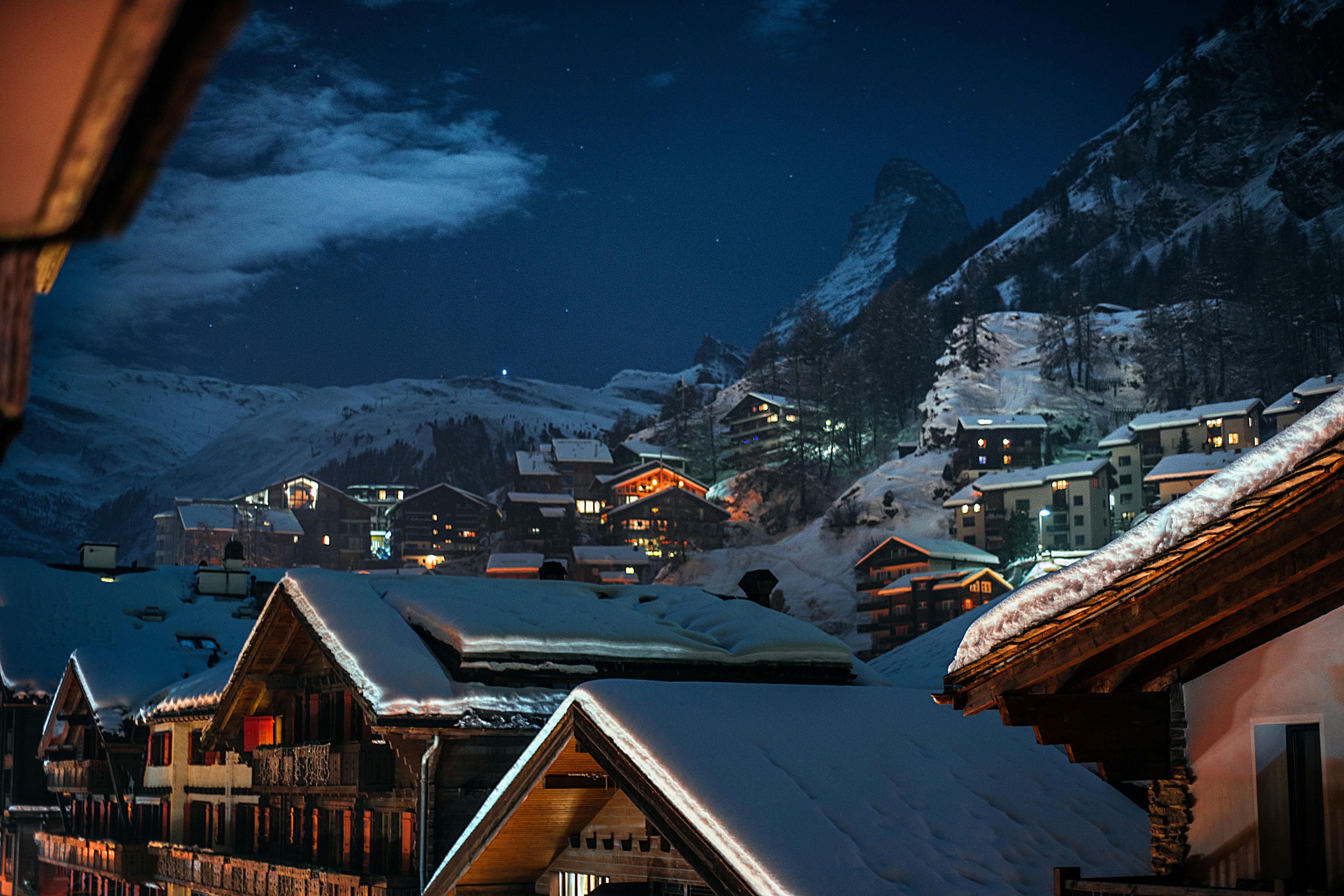
Scenic view of wooden dwelling building facades on mountains with snow under cloudy sky in winter at dusk · Maria Orlova

Switzerland packs more drama per square mile than almost anywhere on earth: glacier-fed rivers, cogwheel railways that climb improbable gradients, and timber chalets stacked beneath peaks that look painted on. The country's mountain towns are where all of that comes together, and many are car-free, reachable only by train or cable car, which keeps them quiet and clean.

This list ranks nine of the most beautiful, weighing the setting, the architecture, the walking and skiing on the doorstep, and how easy they are to reach. Some are world-famous resorts; others are hamlets clinging to a cliff edge that most visitors never see.

Use it to build a trip: the Jungfrau region towns (Grindelwald, Wengen, Mürren, Lauterbrunnen) cluster close enough to combine over a few days, while Zermatt, Saas-Fee, and St. Moritz reward a dedicated base. A Swiss Travel Pass covers most of the trains and many cable cars, so plan around the rail network rather than a car.

1
Zermatt
ZermattValais, southern Switzerland, about 3.5 hours by train from Zurich Google
No mountain in the world announces a town quite like the Matterhorn announces Zermatt, its lopsided pyramid filling the end of the valley. The village is car-free, so you arrive by train and move around on foot, by electric taxi, or by the railways and lifts that fan out across the slopes. Wander the Hinterdorf quarter to see weathered timber granaries raised on stone discs, then ride the Gornergrat cogwheel railway for a panorama taking in 29 peaks over 4,000 meters. Come winter it is one of Europe's great ski resorts; in summer the trails to the Five Lakes, where the Matterhorn reflects in Stellisee, are unforgettable.
  • Sunrise on the Matterhorn from the Gornergrat railway
  • The Five Lakes Walk and Stellisee reflection
  • Matterhorn Glacier Paradise, Europe's highest cable car station
  • Old Hinterdorf timber chalets
Best for: first-time visitors and mountain photographers
Getting there: Train from Zurich or Geneva via Visp, then the Zermatt shuttle (around 3.5 hours total); the village is car-free, so park in Täsch and ride the final train.
2
Grindelwald
GrindelwaldBernese Oberland, about 2.5 hours by train from Zurich Google
Spread across a green shelf beneath the north face of the Eiger, Grindelwald is the postcard Bernese village: chalets, cowbells, and a wall of rock rising almost vertically behind town. The Eiger Express gondola now whisks you toward the Jungfraujoch and the high glacier world in minutes, while the First cable car opens up ridge walks, a cliff-edge walkway, and the toboggan run down toward Bort. It makes an ideal base for the whole Jungfrau region, with Lauterbrunnen, Wengen, and Mürren all within easy reach. Don't leave without walking part of the trail to the Bachalpsee, a still mountain lake that mirrors the Schreckhorn.
  • The Eiger north face from town
  • First Cliff Walk and the ridge hike to Bachalpsee
  • Eiger Express gondola toward Jungfraujoch
  • Pfingstegg toboggan and gorge walks
Best for: a multi-day Jungfrau region base
Getting there: Direct trains from Interlaken Ost (about 35 minutes), roughly 2.5 hours from Zurich with one change.
3
Wengen
WengenBernese Oberland, on a sunny terrace above Lauterbrunnen Google
Perched on a south-facing balcony high above the Lauterbrunnen valley, car-free Wengen feels suspended between the valley floor and the great trio of the Eiger, Mönch, and Jungfrau. You reach it only by the Wengernalpbahn cogwheel railway, which rattles up through meadows where the famous Lauberhorn ski race finishes each January. The village keeps a genteel, old-world resort character, with traditional hotels and almost no traffic noise beyond the trains. From here the path to Männlichen delivers one of the most beautiful ridge walks in the Alps, with the valley dropping away on both sides.
  • Cogwheel ride up the Wengernalpbahn
  • The Männlichen to Kleine Scheidegg ridge walk
  • Lauberhorn World Cup downhill course
  • Eiger, Mönch and Jungfrau views from the village
Best for: a quiet, scenic, car-free stay
Getting there: Train to Lauterbrunnen, then the Wengernalpbahn cogwheel railway up to Wengen (about 15 minutes).
4
Mürren
MürrenBernese Oberland, on a cliff terrace above Lauterbrunnen Google
The highest year-round inhabited village in the Bernese Oberland, Mürren sits on a sheer terrace at around 1,650 meters with the Eiger, Mönch, and Jungfrau filling the horizon directly across the valley. It is gloriously car-free and reached by cable car and mountain railway, which keeps it peaceful even in peak season. The Schilthorn cable car climbs from here to the revolving Piz Gloria restaurant of James Bond fame, and the via ferrata and Thrill Walk give the adventurous a real adrenaline hit. With the valley plunging away beneath the chalets, it is one of the most spectacularly sited villages in Europe.
  • Schilthorn cable car and Piz Gloria revolving restaurant
  • The Mürren via ferrata and Thrill Walk
  • Paragliding over the Lauterbrunnen valley
  • North Face Trail with classic Eiger views
Best for: adventurers and view-seekers who want quiet
Getting there: From Lauterbrunnen via the Grütschalp funicular and mountain train, or via the Stechelberg cable car (about 30 minutes either way).
5
Lauterbrunnen
LauterbrunnenBernese Oberland, about 2.5 hours by train from Zurich Google
Lauterbrunnen lies on the floor of a U-shaped glacial valley so steep and theatrical it is said to have inspired Tolkien's Rivendell. Seventy-two waterfalls spill from the cliffs, the most famous being the Staubbach Falls, which drop almost 300 meters in a single feathery ribbon just behind the village church. Walk or take the bus to the Trümmelbach Falls, glacial torrents that thunder inside the mountain itself through a series of carved galleries. As the rail hub for Wengen, Mürren, and the Jungfraujoch, it is the natural launch point for the whole region.
  • Staubbach Falls behind the village
  • Trümmelbach Falls inside the mountain
  • Valley-floor walk and cycle path to Stechelberg
  • Gateway trains to Wengen, Mürren and Jungfraujoch
Best for: waterfall lovers and a central rail base
Getting there: Direct train from Interlaken Ost (about 20 minutes); roughly 2.5 hours from Zurich with a change at Interlaken.
6
Saas-Fee
Saas-FeeValais, near Zermatt, about 3.5 hours from Zurich Google
Often overshadowed by neighboring Zermatt, car-free Saas-Fee sits in a natural amphitheater ringed by thirteen 4,000-meter peaks, with glaciers tumbling almost to the edge of the village. The Allalin underground funicular climbs to the world's highest revolving restaurant on a glacier, and the surrounding ice gives it some of the most reliable summer skiing in the Alps. The old village core is a tight cluster of dark timber barns and stone-roofed chalets that feels genuinely lived-in rather than staged. It is a quieter, more family-friendly alternative to the big-name resorts, with the same jaw-dropping high-mountain backdrop.
  • Glacier amphitheater of thirteen 4,000m peaks
  • Allalin revolving glacier restaurant
  • Saas-Fee old village barns and chalets
  • Summer skiing and glacier walks
Best for: families and travelers wanting a quieter alternative to Zermatt
Getting there: Train to Visp, then PostBus up to Saas-Fee (about 1 hour from Visp); the village is car-free with parking garages at the entrance.
7
St. Moritz
St. MoritzEngadine, eastern Switzerland, about 3.5 hours by train from Zurich Google
High in the Engadine valley at around 1,800 meters, St. Moritz pairs Alpine scenery with glossy resort glamour, set beside a frozen lake that hosts horse racing and polo on the ice each winter. Beyond the designer boutiques, the surrounding landscape of larch forests, turquoise lakes, and the Bernina massif is genuinely beautiful and threaded with superb hiking and cycling trails. The town is the terminus of two of the world's most scenic rail journeys, the Glacier Express and the Bernina Express, the latter crossing the UNESCO-listed Landwasser Viaduct. Time a visit for the crisp light of late winter or the wildflower meadows of June and July.
  • Arrival on the Bernina Express over the Landwasser Viaduct
  • Frozen lake events like White Turf horse racing
  • Hikes around the Engadine lakes and Muottas Muragl
  • Glacier Express departures toward Zermatt
Best for: scenic rail journeys and a touch of glamour
Getting there: Train from Zurich via Chur (about 3.5 hours), or arrive in style on the Bernina or Glacier Express.
8
Engelberg
EngelbergCentral Switzerland, about 1 hour by train from Lucerne Google
Backed by the glaciated bulk of Mount Titlis, Engelberg grew up around a Benedictine monastery that still anchors the village and produces its own cheese. It is the most accessible high-mountain town from Lucerne and Zurich, which makes it a popular day trip, but it rewards an overnight with quiet evenings and early starts on the slopes. The Titlis Rotair, the world's first revolving cable car, climbs to a glacier with an ice cave and a vertiginous cliff walk, while the Brunni side offers gentler hikes and the Trübsee lake. For all the snow above, the valley itself stays green and pastoral well into summer.
  • Titlis Rotair revolving cable car and glacier ice cave
  • Engelberg Abbey and its cheese dairy
  • Trübsee lake and the Brunni hiking trails
  • Titlis Cliff Walk suspension bridge
Best for: an easy mountain escape from Lucerne or Zurich
Getting there: Direct train from Lucerne (about 45 minutes) through the Engelberg valley.
9
Andermatt
AndermattUri, central Switzerland, about 1.5 hours by train from Lucerne Google
Sitting at the crossroads of historic Alpine passes, Andermatt has quietly transformed from a sleepy garrison town into one of central Switzerland's most appealing year-round mountain bases, without losing its compact old core of stone houses and a baroque church. It is a junction on the Glacier Express line and the gateway to the Furka, Gotthard, and Oberalp passes, making it a dream for drivers, cyclists, and rail fans alike. The Gemsstock cable car opens up serious off-piste terrain in winter and high ridge walks in summer, with views deep into the surrounding ranges. The nearby Schöllenen Gorge and its Devil's Bridge add a dose of legend and drama to any visit.
  • Glacier Express over the Oberalp Pass
  • Gemsstock cable car for off-piste and ridge views
  • Schöllenen Gorge and the Devil's Bridge
  • Old village core and baroque church
Best for: rail and road-trip travelers and serious skiers
Getting there: Train from Lucerne via Göschenen or the Matterhorn Gotthard line (about 1.5 hours).

Good to Know

Getting around Most of these towns are reached by train, cogwheel railway, or cable car rather than car, and several (Zermatt, Wengen, Mürren, Saas-Fee) are entirely car-free. Plan around the rail timetable, which is famously punctual.
Passes A Swiss Travel Pass covers trains, buses, and boats plus many cable cars, and gives discounts on the high mountain lifts like Jungfraujoch and Titlis. For a focused Jungfrau trip, look at the regional Jungfrau Travel Pass instead.
When to go July to September brings wildflower meadows and the full hiking network; December to April is for skiing and snow. Late spring and November are shoulder seasons when some lifts and hotels close, so check ahead.
Book ahead High-mountain excursions to Jungfraujoch and the Schilthorn sell timed tickets that fill up in summer, and car-free villages have limited parking garages at their entrances. Reserve both in advance in peak months.

From the Matterhorn's perfect cone above Zermatt to the waterfall-laced cliffs of Lauterbrunnen, Switzerland's mountain towns deliver scenery that holds up to any amount of hype. String a few together by train, give yourself time to ride at least one high cable car and walk one ridge, and you will see why these villages top so many travelers' lists. Start with one base, build outward, and let the timetable do the planning for you.

Ready to book your trip?

Search Hotels
Search Homes

Traveling somewhere else?

Generate a custom itinerary