
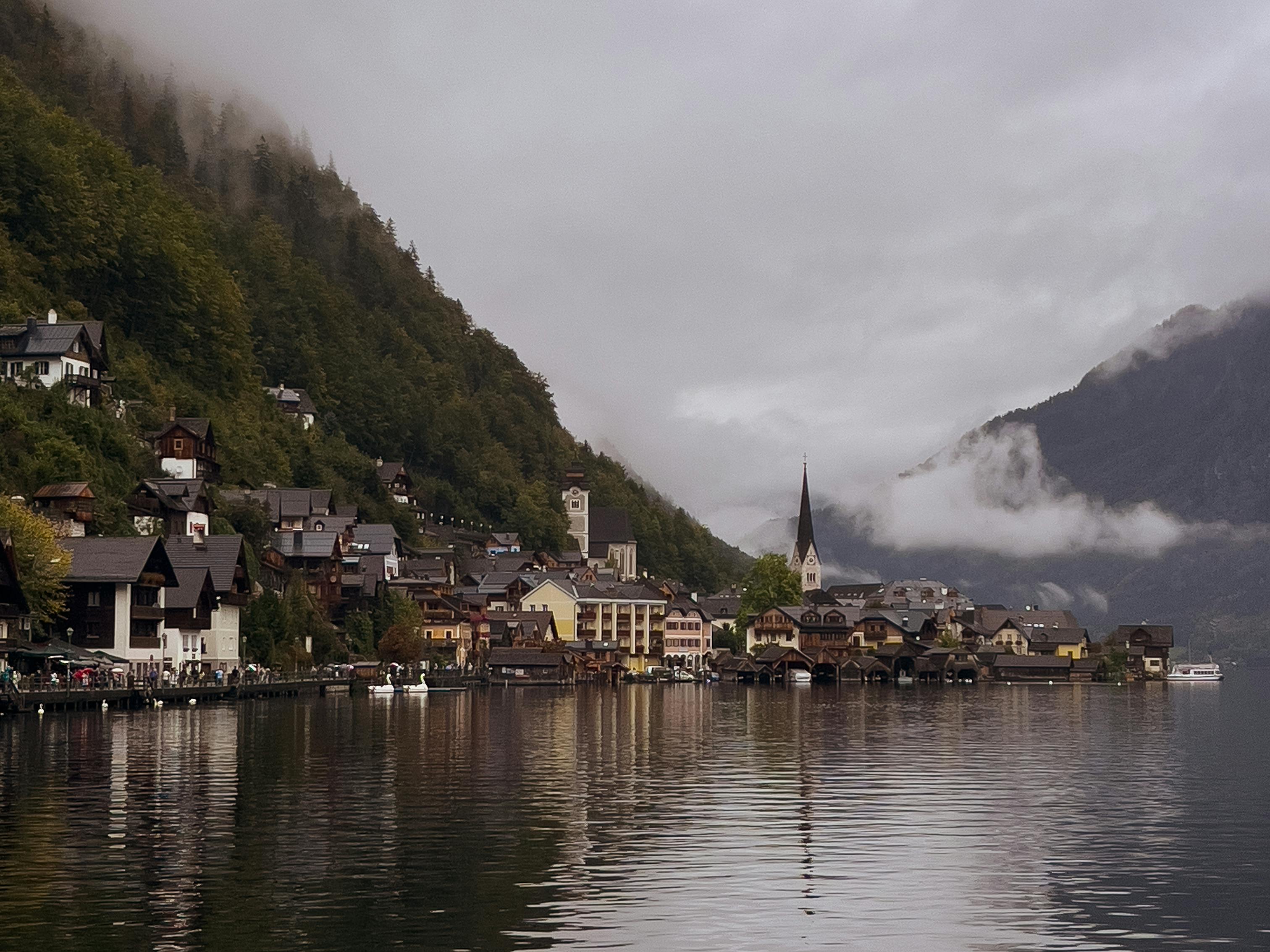
Picturesque village by the lake with misty mountains and charming architecture on a cloudy day.
List · Austria 8 picks

The 8 Most Beautiful Small Towns in Austria, Ranked

From the lakeside houses of Hallstatt to the wine terraces of the Wachau, these are the Austrian towns worth crossing the country for.

Last updated June 30, 202611 min read
Top pick

Hallstatt is the most beautiful all-rounder and the one image everyone knows; choose Durnstein for a wine-country day from Vienna, or Alpbach if you want the quintessential flower-decked alpine village without the crowds.

Austria packs an outsized number of postcard towns into a country smaller than Maine: lakeside villages mirrored in glassy water, alpine hamlets ringed by limestone peaks, and Danube wine towns crowned by ruined castles. The hard part is not finding a pretty place, it is choosing between them.

This list ranks eight of the country's most beautiful small towns, weighing not just looks but how rewarding each is to actually visit: what you can walk to, eat, and do once the camera is away. Most are reachable by train or a scenic drive from Salzburg, Vienna, or Innsbruck, so several can be strung together.

Use the comparison details on each entry to plan: where it is, how to get there, and who it suits, whether you want a quiet overnight, a family base, or a half-day stop on a bigger loop.

Hallstatt1tours from $98.74
Hallstatt Google
Salzkammergut, about 1 hour 15 minutes from Salzburg
The most photographed village in Austria earns its fame: pastel houses stack up a near-vertical slope between a dark lake and the Dachstein massif, with a slim church spire reflected in the water. Beyond the famous viewpoint, ride the funicular to the Skywalk platform and the world's oldest salt mine, wander the tiny Marktplatz, and visit the eerie Beinhaus (Bone House) beside the parish church. It is busy by mid-morning, so arrive early or stay overnight to have the lanes to yourself at dawn. Note that day-trippers are now managed by a booking and parking system, so check ahead if driving.
  • The classic lakeside viewpoint above the Gosaumühlstraße
  • Salzwelten, the oldest salt mine in the world, reached by funicular
  • The Beinhaus charnel house with painted skulls
  • 5fingers viewing platform on Dachstein Krippenstein
Best for First-time visitors and photographers
Getting there About 1h15 by car from Salzburg, or train to Hallstatt station plus a short ferry across the lake; half-day coach tours run from Salzburg
Dürnstein2
Dürnstein Google
Wachau Valley, about 1 hour 15 minutes west of Vienna
This blue-and-white baroque town clings to the Danube beneath the ruined castle where Richard the Lionheart was held prisoner in 1192. The standout sight is the powder-blue tower of the Stift Dürnstein abbey church, glowing above the river and the surrounding apricot orchards and vineyards. Climb the 20-minute trail to the castle ruin for sweeping valley views, then taste the region's crisp Grüner Veltliner and Riesling at a Heuriger wine tavern. In spring the apricot blossom turns the whole valley pink, and autumn brings the harvest.
  • The cobalt-blue baroque tower of Stift Dürnstein
  • Hiking up to Kuenringer Castle ruins for Danube views
  • Wachau Grüner Veltliner and Riesling tastings
  • Apricot products, from jam to schnapps
Best for Wine lovers and a scenic day from Vienna
Getting there About 1h15 by car or train (via Krems) from Vienna; many do it by Danube river cruise or cycling the Wachau bike path
Alpbach3
Alpbach Google
Tyrol, about 45 minutes east of Innsbruck
Repeatedly voted Austria's prettiest village, Alpbach is a tidy cluster of dark-timber chalets with flower-filled balconies set on a sunny mountain shelf in the Alpbachtal. Strict building rules have kept it uniformly traditional, so there is no jarring modern architecture to break the spell. In summer it is a hiking and cow-bell base; in winter the Ski Juwel area links it with neighbouring Wildschönau. Don't miss the open-air Museum Tiroler Bauernhöfe nearby, a collection of relocated historic farmhouses.
  • The all-timber village center, famously flower-decked in summer
  • Hiking the Wiedersbergerhorn cable car trails
  • Ski Juwel Alpbachtal Wildschönau ski area
  • Museum Tiroler Bauernhöfe open-air farmhouse museum
Best for Alpine scenery, hikers, and skiers
Getting there About 45 min by car from Innsbruck; or train to Brixlegg then a local bus up the valley
Zell am See4
Zell am See Google
Salzburg state, about 1 hour 20 minutes south of Salzburg
Wrapped around a clear alpine lake with the Kitzsteinhorn glacier as a backdrop, Zell am See pairs a walkable medieval core with serious mountain access. Stroll the lakeside Esplanade, swim or take a boat in summer, then ride the gondola up Schmittenhöhe for panoramic ridge walks. It is the gateway to the Grossglockner High Alpine Road and the Kitzsteinhorn glacier, where you can reach snow and big views even in midsummer. The compact old town has the late-Gothic Hippolytkirche and plenty of cafes for cake by the water.
  • Lake Zell boat trips and the lakeside Esplanade
  • Schmittenhöhe gondola for panoramic hikes
  • Kitzsteinhorn glacier and the Grossglockner High Alpine Road
  • The Romanesque-Gothic St. Hippolyt church
Best for Lake-and-mountain combos and active families
Getting there About 1h20 by car from Salzburg, or roughly 1h30 by direct train
St. Wolfgang im Salzkammergut5
St. Wolfgang im Salzkammergut Google
Salzkammergut, about 50 minutes east of Salzburg
On the shore of the Wolfgangsee, this lake town is best known for the White Horse Inn (Weißes Rössl) made famous by the operetta, and for the historic cog railway that climbs the Schafberg. The pilgrimage church holds a celebrated late-Gothic altarpiece by Michael Pacher, one of the finest in Austria. Ride the steam-hauled Schafbergbahn to the 1,783m summit for a view over half a dozen Salzkammergut lakes, then cool off with a lakeside swim. It is calmer and prettier than its busier neighbour St. Gilgen across the water.
  • The Schafbergbahn cog railway to a multi-lake panorama
  • Michael Pacher's Gothic winged altar in the pilgrimage church
  • The historic Weißes Rössl (White Horse Inn) lakefront
  • Swimming and boat trips on the Wolfgangsee
Best for A relaxed lake stop with a classic railway
Getting there About 50 min by car from Salzburg; or bus to Strobl/St. Gilgen plus the lake ferry
Gmunden6
Gmunden Google
Salzkammergut, about 1 hour 10 minutes from Salzburg
At the northern end of the Traunsee, Gmunden is a graceful lake town with a genuine fairy-tale set piece: Schloss Ort, a moated castle on a tiny island reached by a wooden footbridge. The town is the home of Gmundner Keramik, the green-flamed ceramics you see all over Austria, and you can tour the workshop and buy seconds. A lakeside promenade, a tramway billed as one of the world's shortest, and the Grünberg cable car round out an easygoing day. The Traunstein peak looms dramatically over the far shore.
  • Seeschloss Ort, the island castle on the Traunsee
  • The Gmundner Keramik ceramics factory and shop
  • Grünberg cable car for views over the lake and Traunstein
  • Strolling the lakeside Esplanade
Best for Slower-paced lake days and ceramics fans
Getting there About 1h10 by car from Salzburg, or train to Gmunden (via Attnang-Puchheim)
Hall in Tirol7
Hall in Tirol Google
Tyrol, about 15 minutes east of Innsbruck
Just downstream from Innsbruck, Hall has one of the largest and best-preserved medieval old towns in the western Alps, yet sees a fraction of the crowds. Its wealth came from salt and from minting coins: the Münze Hall mint museum lets you strike your own replica taler. Wander the stepped lanes around the Oberer Stadtplatz and the Gothic St. Nikolaus parish church, then climb the Münzerturm tower for rooftop views to the Karwendel range. It makes an easy, atmospheric half-day from Innsbruck.
  • The Münze Hall mint museum and Münzerturm tower
  • The medieval Oberer Stadtplatz and stepped old-town lanes
  • Gothic St. Nikolaus parish church
  • Views to the Karwendel mountains
Best for History lovers and an easy trip from Innsbruck
Getting there About 15 min by car, S-Bahn train, or tram/bus from Innsbruck
Rust8
Rust Google
Burgenland, about 1 hour southeast of Vienna
On the western shore of the reed-fringed Lake Neusiedl, Rust is a small wine town famous for two things: storks and sweet wine. From spring to late summer, white storks nest on the chimneys of its pastel baroque and Renaissance houses, a sight protected by the town for centuries. This is the home of Ruster Ausbruch, a prized dessert wine, and the surrounding cellars and Heurigen pour generously. Cycle or boat on the shallow lake, a UNESCO-listed cultural landscape shared with Hungary, then return for wine on a sun-warmed square.
  • White storks nesting on the chimneys in summer
  • Tasting Ruster Ausbruch sweet wine in local cellars
  • Cycling and boating on Lake Neusiedl
  • The Fischerkirche, a fortified medieval church
Best for Wine and birdwatching on a warm-weather day
Getting there About 1h by car from Vienna; or train to Eisenstadt plus a connecting bus

Want these spots worked into your trip?

We'll build a custom Austria itinerary around the places you pick.

Generate itinerary
Good to know

Before you go

Getting aroundAustria's trains (ÖBB) reach most of these towns, but lake and alpine villages often need a final bus or ferry; a car gives the most flexibility for the Salzkammergut and Wachau. Check ÖBB and Postbus timetables together when planning connections.
When to goLate spring (May-June) and September bring good weather and thinner crowds. July-August is busiest, especially in Hallstatt and at the lakes, while many alpine cable cars and lake ferries run only roughly May to October.
Beat the Hallstatt crowdsHallstatt is overwhelmed with day-trippers from late morning. Arrive before 9am or stay overnight, and note the village's visitor management, including pre-booked parking, if you arrive by car.
Combine townsHallstatt, St. Wolfgang, and Gmunden sit within the Salzkammergut and pair well over two or three days, while Dürnstein and Rust both work as wine-country days from Vienna in opposite directions.

Austria's small towns reward slowing down: a dawn walk in Hallstatt, a glass of Grüner Veltliner above the Danube in Dürnstein, or cake on a lakeside Esplanade in Gmunden. Pick one as a base or thread several together by train and scenic drive, and you will see a quieter, more local Austria than the big cities alone can offer.

Frequently asked questions

Which Austrian small town is best for a day trip from Salzburg?
Hallstatt is the headline choice, about 1h15 away by car or via a train-and-ferry combination, and is well served by half-day coach tours. St. Wolfgang and Gmunden are closer and quieter alternatives in the same Salzkammergut lake district.
What is the prettiest village in Austria?
Hallstatt is the most famous and instantly recognizable, but Alpbach in Tyrol has repeatedly been voted Austria's prettiest village for its uniformly traditional timber chalets. Dürnstein on the Danube is the standout for baroque riverside charm.
How do you get to Dürnstein from Vienna?
It is about 1h15 by car or by train via Krems, from where a local connection or short taxi reaches Dürnstein. Many visitors arrive instead by Danube river cruise or by cycling the scenic Wachau bike path.
Which Austrian small town is best for skiing or alpine scenery?
Alpbach, linked to the Ski Juwel Alpbachtal Wildschönau area, and Zell am See, with its glacier-backed lake and access to the Kitzsteinhorn, are the strongest picks for mountain scenery and winter sports.
Are these towns reachable without a car?
Most are reachable by ÖBB train plus a local bus or ferry. Hall in Tirol (S-Bahn from Innsbruck), Zell am See, and Gmunden have direct or near-direct rail links, while lake and valley villages like St. Wolfgang and Alpbach require a final bus or boat leg.
Plan with MagicTrips

Build your own Austria trip

Tell us how many days, your budget, and what you're into. We'll turn it into a custom, day-by-day Austria itinerary.

Ready to book your stay?

Hotels
Homes

Traveling somewhere else?

Generate a custom itinerary