
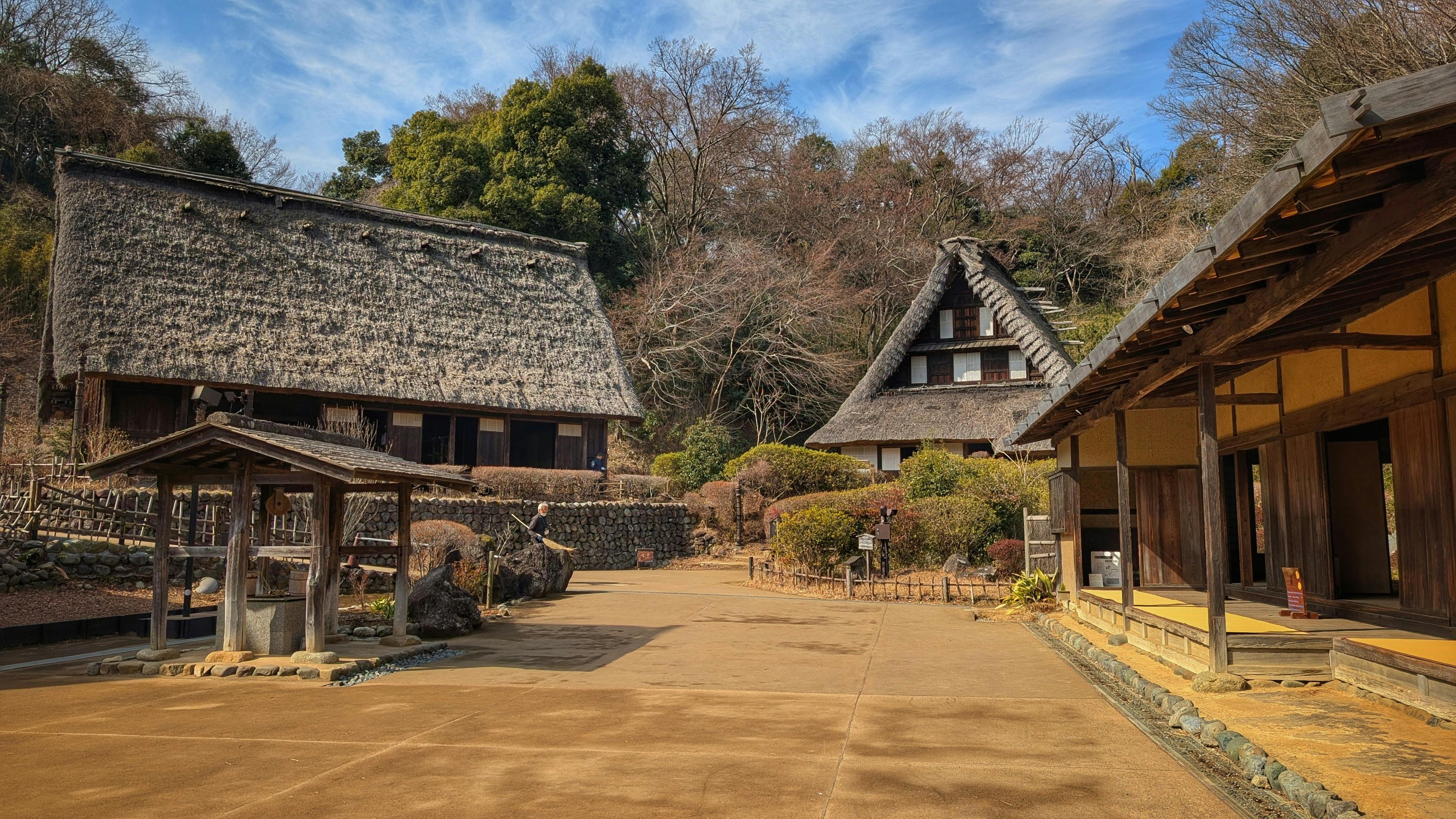
Explore the serene traditional thatched-roof village in Kawasaki, Kanagawa, Japan, capturing rural tranquility.
List · Kyoto 8 picks

The 8 Best Small Towns Near Kyoto for a Slower, Quieter Escape

Thatched farmhouses, canal-lined merchant streets, matcha fields, and mountain shrine villages, all within easy reach of Kyoto Station.

Last updated July 2, 202611 min read
Top pick

Uji is the best all-rounder for a half-day trip (matcha, a UNESCO temple, and just 20 minutes by train); choose Miyama for storybook thatched-roof countryside or Kibune for a cool mountain escape in summer.

Kyoto rewards anyone willing to ride 30 to 90 minutes past its temple crowds. Within an easy radius sit tea-growing towns, thatched farming hamlets, canal-threaded merchant quarters, and mountain shrine villages where the pace drops noticeably and lunch still runs on local time.

This list favors genuinely small, walkable places over big cities, ranked by how special they are and how simply you can reach them from Kyoto Station or the connecting private lines. Each entry notes what to see, what to eat, who it suits, and exactly how to get there.

Most of these work as a half or full day out; a couple (Ine, Miyama) reward an overnight if you can spare it. Use the comparison details on each entry to match a town to your mood, whether that is matcha and temples or empty lanes and mountain air.

Uji1tours from $122.54
Uji Google
20-30 minutes south of Kyoto
Uji is Japan's spiritual home of green tea, and the aroma of roasting matcha drifts down its main street toward the Uji River. The showpiece is Byodo-in, the Phoenix Hall that appears on the 10-yen coin, set behind a reflecting pond that doubles it perfectly on still mornings. Tea houses along Byodoin Omotesando serve stone-ground matcha, hojicha soft serve, and cha-soba noodles, while the atmospheric Ujigami Shrine across the river is one of Japan's oldest Shinto structures. It is the most rewarding short trip from Kyoto for anyone who wants tea culture, a world-class temple, and a riverside stroll in one compact package.
  • Byodo-in Phoenix Hall and its garden
  • Grinding and tasting matcha at a tea house
  • Ujigami Shrine, a UNESCO World Heritage site
  • Matcha and hojicha soft serve on Byodoin Omotesando
Best for tea lovers and first-time day-trippers
Getting there 20-30 minutes from Kyoto Station on the JR Nara Line rapid (about ¥240), or via the Keihan Uji Line
Ohara2
Ohara Google
About 1 hour north of Kyoto
Tucked in a mountain basin north of the city, Ohara feels like the Kyoto countryside of a century ago, all rice paddies, cedar slopes, and moss gardens. The main draw is Sanzen-in, a serene temple famous for its emerald moss garden dotted with small stone Jizo figures and blazing maples in November. A short walk uphill leads to Hosen-in, where you sit with matcha and view a 700-year-old pine framed like a living painting. It is the easiest way to swap Kyoto's bustle for birdsong and pickled-vegetable shops without straying far.
  • Sanzen-in's moss garden and stone Jizo statues
  • Matcha and the framed garden view at Hosen-in
  • Shiso pickles (shibazuke) from local shops
  • Autumn maples in the temple grounds
Best for temple gardens and a peaceful half day
Getting there About 60-70 minutes on Kyoto Bus 17 from Kyoto Station (around ¥560)
Kibune and Kurama3
Kibune and Kurama Google
30-40 minutes north of central Kyoto · 4.6 · 5,612 reviews
These twin mountain villages sit on either side of a forested ridge and are best done together as a temple-to-temple hike. Kibune clusters around Kifune Shrine, whose lantern-lined stone staircase is one of Kyoto's most photographed approaches; in summer, restaurants build kawadoko platforms right over the rushing stream so you dine to the sound of cold water. Cross the pass on the wooded trail to Kurama-dera, an atmospheric mountain temple, then soak at Kurama Onsen. The valley runs several degrees cooler than the city, making it a genuine escape on hot days.
  • The lantern-lined stairway at Kifune Shrine
  • Riverside kawadoko dining in summer
  • The hike over the pass to Kurama-dera
  • An outdoor bath at Kurama Onsen
Best for a summer escape and easy hiking
Getting there Eizan Railway from Demachiyanagi Station to Kibune-guchi or Kurama, about 30 minutes (around ¥470)
Miyama (Kayabuki no Sato)4
Miyama (Kayabuki no Sato) Google
About 1.5-2 hours northwest of Kyoto · 4.3 · 9,760 reviews
Miyama's Kayabuki no Sato is a preserved hamlet of nearly 40 thatched-roof farmhouses set against terraced fields and forested hills, one of the best places in western Japan to see this vanishing architecture. You can walk the whole village in an hour, visit the folk museum inside a working kaya-buki house, and watch the red water-cannon test that fires each spring and autumn to protect the roofs from fire. It is quiet, deeply rural, and especially magical under snow or when the fields turn gold. Getting here takes effort by public transport, so many visitors join a tour or drive.
  • The thatched farmhouses of Kayabuki no Sato
  • The Miyama Folk Museum inside a kaya-buki house
  • Seasonal fire-cannon (hosui) display
  • Local soba and sansai (mountain vegetable) meals
Best for photographers and countryside seekers
Getting there JR to Hiyoshi Station (about 1 hour), then the Nantan/Miyama bus to Kayabuki no Sato (35-50 minutes); a rental car or tour is easier
Omihachiman5
Omihachiman Google
About 35-50 minutes east of Kyoto
This former merchant town on the shore of Lake Biwa grew rich from the traveling Omi merchants, and their legacy survives in a canal district of white-walled storehouses and willow-lined water. Boat rides glide along the Hachiman-bori canal past old kura warehouses, while the Shinmachi-dori street preserves handsome merchant homes you can tour. Ride the ropeway up Hachimanyama for a wide view over the lake and rooftops, then try local clam rice or a slice of the town's famous baumkuchen. It is an easy, underrated day out that feels a world away from Kyoto's temples.
  • A boat ride on the Hachiman-bori canal
  • Merchant houses along Shinmachi-dori
  • Lake Biwa views from the Hachimanyama ropeway
  • Club Harie baumkuchen and Omi beef
Best for history buffs and relaxed strolling
Getting there 35-50 minutes on the JR Biwako Line from Kyoto Station to Omihachiman (around ¥680)
Sakamoto (Otsu)6
Sakamoto (Otsu) Google
About 20-30 minutes east of Kyoto
At the foot of Mount Hiei, Sakamoto is a temple town defined by its extraordinary Ano-shu stone walls, dry-fitted masonry built by a guild of master masons centuries ago. The star sight is Saikyo-ji and, above all, the retirement temples known as satobo, where you can view meticulous gardens with hardly another visitor. From here the Sakamoto Cable Car climbs to Enryaku-ji, the vast mountaintop monastery that is a UNESCO World Heritage site. Quiet, green, and rich in history, it makes an easy antidote to a crowded Kyoto morning.
  • Ano-shu stone walls throughout the town
  • The gardens of Saikyo-ji and its satobo
  • The Sakamoto Cable Car up to Enryaku-ji
  • Soba shops beneath the cedar trees
Best for a quiet half day and mountain temples
Getting there About 20-25 minutes from Kyoto on the JR Kosei Line to Hieizan-Sakamoto (around ¥330)
Hikone7
Hikone Google
About 50 minutes east of Kyoto
Hikone centers on one of Japan's twelve original surviving castle keeps, a compact black-and-white fortress that has never been rebuilt and still crowns its hilltop moats. Below it, the Genkyu-en garden offers classic pond-and-pavilion views of the keep, and the reconstructed Yumekyobashi Castle Road recreates an Edo merchant street with sweet shops and souvenir stalls. Time it right and you might catch Hikonyan, the town's samurai-cat mascot, making an appearance. It pairs a genuine feudal landmark with lakeside calm, and works well combined with Omihachiman on a Lake Biwa loop.
  • Hikone Castle, an original Edo-era keep
  • Genkyu-en garden with castle views
  • Edo-style Yumekyobashi Castle Road
  • Lake Biwa sunsets
Best for castle and history fans
Getting there About 50 minutes on the JR Biwako Line from Kyoto to Hikone (around ¥1,170)
Ine8
Ine Google
On the Sea of Japan, about 2.5-3 hours north of Kyoto
Ine is a fishing village unlike anywhere else in Japan, its 230 or so funaya boat houses built right at the water's edge, with boat garages below and living quarters above so the whole town seems to float. A sightseeing boat or small local ferry gives the best perspective, gliding past the wooden facades while black kites wheel overhead. Seafood is the reason to linger, from just-caught sashimi to grilled fish at harborside eateries, and a couple of funaya now welcome overnight guests. It is a long haul from Kyoto but genuinely one of the most memorable villages in the region, ideally combined with the sandbar at nearby Amanohashidate.
  • The funaya boat houses lining the bay
  • A sightseeing boat around Ine Bay
  • Fresh seafood at harborside restaurants
  • An overnight stay in a converted funaya
Best for a scenic overnight and seafood
Getting there Train to Amanohashidate (about 2 hours via limited express), then a local bus to Ine (about 1 hour); a car makes it easier

Want these spots worked into your trip?

We'll build a custom Kyoto itinerary around the places you pick.

Generate itinerary
Good to know

Before you go

Passes and ticketsMany of these towns sit on JR lines, so a regional pass like the JR Kansai Wide Area Pass can cover Uji, Omihachiman, Hikone, and the route toward Amanohashidate. Kibune/Kurama and Ohara use private railways and city buses instead, so buy those fares separately.
When to goAutumn (mid-November) is peak for Ohara, Uji, and Hikone maples, while summer suits Kibune for its cool riverside dining. Miyama and Ine are quietest and most atmospheric on weekdays and outside the New Year period.
Start earlyTrains and buses to the farther spots (Miyama, Ine) thin out in the afternoon, and rural restaurants often close by mid-afternoon. Aim to leave Kyoto before 9am for anything beyond an hour away.
Bring cashSmaller temples, village buses, and family-run eateries in these towns may not take cards. Carry enough yen for the day, especially in Miyama, Ohara, and Ine.

From Uji's tea houses to Ine's floating boat houses, the countryside around Kyoto packs an astonishing range of experiences into short train and bus rides. Pick one or two that match your season and your pace, set out early, and you will trade the temple crowds for something quieter and often more memorable. Build a couple of these into your Kyoto itinerary and the old capital opens up far beyond its famous center.

Frequently asked questions

Which small town near Kyoto is best for a short day trip?
Uji is the easiest and most rewarding, just 20-30 minutes by JR from Kyoto Station, with matcha tea houses, the UNESCO-listed Byodo-in temple, and a scenic riverside walk you can cover in a half day.
What is the most scenic countryside village near Kyoto?
Miyama's Kayabuki no Sato, with its cluster of nearly 40 thatched-roof farmhouses among terraced fields, is the most storybook rural village, though it takes about 1.5-2 hours to reach and is easiest by car or tour.
Which town near Kyoto is best in summer?
Kibune, a mountain village about 30 minutes north by Eizan Railway, runs noticeably cooler than the city and is famous for kawadoko platforms where restaurants serve meals over a rushing stream.
Can you visit Ine as a day trip from Kyoto?
You can, but it is a long day: about 2.5-3 hours each way via Amanohashidate. Because of the distance and the beauty of the funaya boat houses at dusk, staying overnight in a converted boat house is well worth it if you have the time.
Are these towns doable without a car?
Most are: Uji, Omihachiman, Hikone, and Sakamoto are on JR lines, and Kibune/Kurama and Ohara are reached by private rail and city bus. Miyama and Ine are the only ones where a rental car or organized tour makes the trip significantly smoother.
Plan with MagicTrips

Build your own Kyoto trip

Tell us how many days, your budget, and what you're into. We'll turn it into a custom, day-by-day Kyoto itinerary.

Ready to book your stay?

Hotels
Homes

Traveling somewhere else?

Generate a custom itinerary