
The 8 Best Day Trips From Lisbon (Palaces, Beaches and Medieval Towns)

From fairy-tale Sintra to the giant waves of Nazaré, here are the day trips that make Lisbon the perfect base for exploring Portugal.
The 8 Best Day Trips From Lisbon (Palaces, Beaches and Medieval Towns)
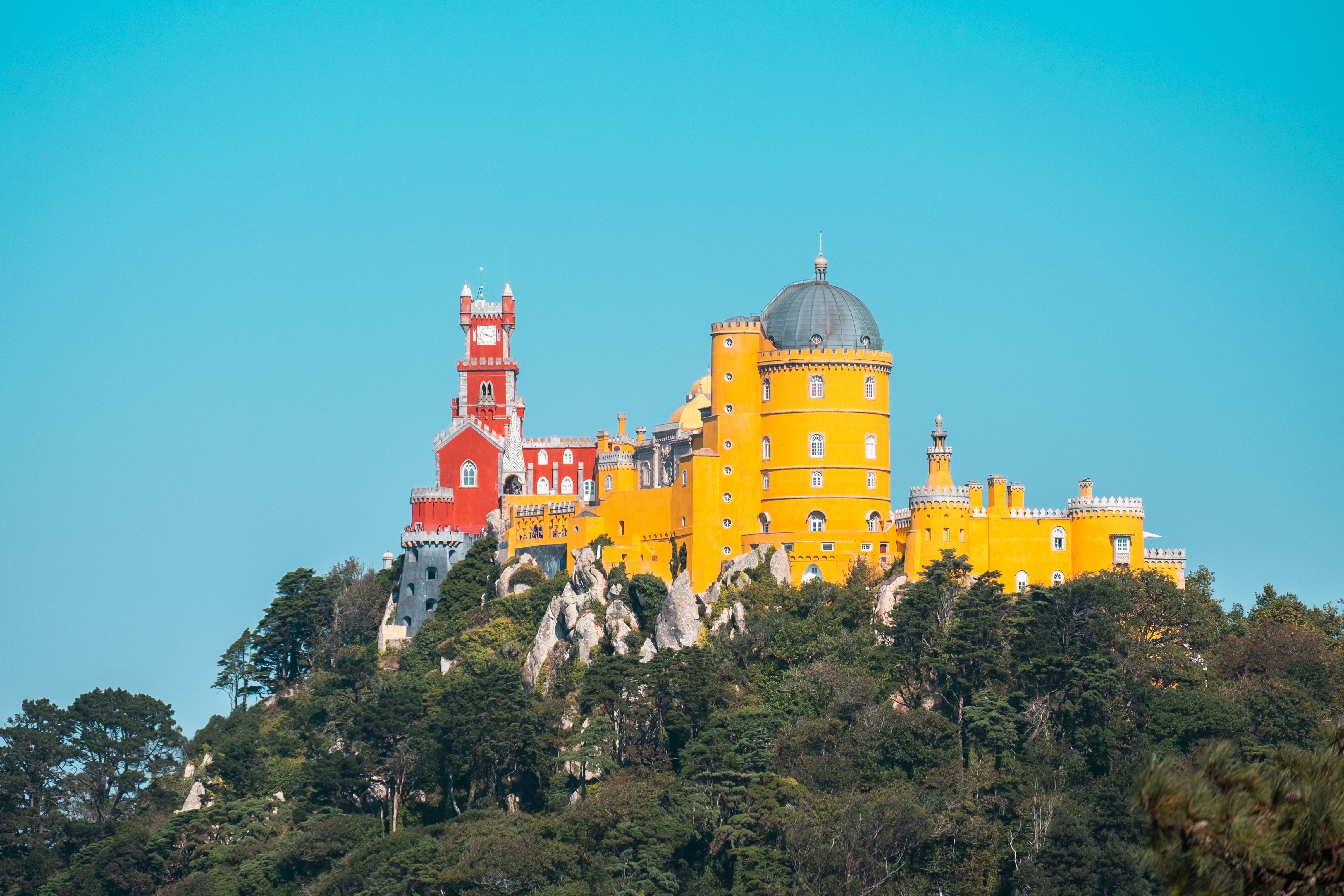
The colorful Pena Palace sits atop a hillside, surrounded by lush greenery under a clear blue sky in Sintra, Portugal. · Mo Eid

Lisbon rewards you for staying put, but it also sits within easy striking distance of some of Portugal's greatest hits. In under an hour you can swap the capital's trams and tiled facades for a mist-wrapped mountain palace, a surf town with record-breaking waves, or a Roman temple ringed by olive groves.

What makes Lisbon such a brilliant base is the variety. North lie medieval villages and pilgrimage towns; west are clifftop beaches and the romantic hills of Sintra; south, across the Tagus, you find white-sand coves and seafood worth the drive. Trains and buses reach most of these places cheaply, and a few are easiest with a small-group tour.

This list is ranked best-first, but the right pick depends on your taste: history, beaches, wine, or just a slower pace. Each entry tells you what to see and eat, how to get there, and who it suits, so you can build a day that fits.

1
Sintra
SintraAbout 40 minutes northwest of Lisbon Google
Sintra is the day trip almost everyone takes, and for good reason: a green, often misty range of hills studded with palaces and estates that look pulled from a storybook. The headline act is the candy-colored Pena Palace, but the spiraling initiation well and grottoes of Quinta da Regaleira are arguably more memorable, and the ruined Moorish Castle gives you sweeping views over the whole valley. The historic center is small and walkable, full of pastry shops selling the local travesseiros and queijadas. Go early and prebook palace tickets, because Sintra gets genuinely crowded by midday.
  • Pena Palace and its terraces
  • Quinta da Regaleira's Initiation Well
  • Moorish Castle ramparts
  • Travesseiros from Piriquita
Best for: first-time visitors, palace and garden lovers
Getting there: Frequent trains from Lisbon's Rossio station take about 40 minutes; tours add Cascais and Cabo da Roca
2
Cascais
CascaisAbout 40 minutes west of Lisbon Google
A former fishing village turned breezy seaside resort, Cascais pairs an easy coastal-rail journey with sandy beaches, a pretty marina, and a walkable old town of cobbled lanes and pastel houses. Wander out to the dramatic Boca do Inferno sea cleft, rent a bike to ride the windswept path toward Guincho beach, or browse the small but worthwhile Paula Rego museum. It is more relaxed than Sintra and works beautifully as a half-day add-on or a slow lunch-and-swim escape. Seafood is the move here: grilled fish and prawns at a terrace by the water.
  • Boca do Inferno
  • Praia da Rainha in the town center
  • The bike path to Guincho beach
  • Casa das Histórias Paula Rego
Best for: beach days, a relaxed coastal afternoon
Getting there: Direct trains along the coast from Lisbon's Cais do Sodré take about 40 minutes; often combined with Sintra on tours
3
Óbidos
ÓbidosAbout 1 hour north of Lisbon Google
Óbidos is the postcard medieval town: a complete ring of whitewashed houses inside intact stone walls, with bougainvillea spilling over doorways and a castle now run as a hotel. You can walk the full circuit of the ramparts for views over red roofs and surrounding countryside, then duck into the cobbled main street, Rua Direita. Stop for ginjinha, the local sour-cherry liqueur, served in a small chocolate cup you eat afterward. It is compact enough to see in a few hours, which makes it a natural pairing with Nazaré or Fátima.
  • Walking the medieval town walls
  • Ginjinha in a chocolate cup
  • Rua Direita's shops and tilework
  • The castle and main gate, Porta da Vila
Best for: history lovers, a charming half-day
Getting there: Direct buses from Lisbon's Campo Grande take about an hour; commonly combined with Nazaré and Fátima on tours
4
Évora
ÉvoraAbout 1.5 hours east of Lisbon, in the Alentejo Google
The historic capital of the Alentejo, Évora is a UNESCO-listed town where Roman, medieval, and Renaissance layers sit within easy walking distance of one another. The Roman Temple of Diana stands remarkably intact, and the eerie Chapel of Bones, lined with the remains of thousands of monks, is unforgettable. Beyond the monuments it is the gateway to the Alentejo's wine country, so plan a long lunch of black pork, lamb stew, and a glass of robust local red. It is the best day trip for travelers who want history and food without coastal crowds.
  • Roman Temple of Diana
  • Capela dos Ossos (Chapel of Bones)
  • Évora Cathedral and its rooftop
  • Alentejo wine and black pork
Best for: history buffs, wine and food lovers
Getting there: Trains and buses from Lisbon take about 1.5 hours; a car helps if you want to add a winery
5
Arrábida and Setúbal
Arrábida and SetúbalAbout 45 minutes south of Lisbon Google
4.8 · 29,077 reviews
Just south across the river, the Serra da Arrábida is a limestone ridge that drops to some of the clearest, most turquoise water near Lisbon. The beaches at Portinho da Arrábida and Galápos feel almost Mediterranean, backed by green hills and a protected nature park. Base yourself in the working port of Setúbal, famous for fried cuttlefish (choco frito) and a vibrant fish market, and consider a boat trip to spot the resident bottlenose dolphins in the Sado estuary. This is the local's beach escape, far less touristy than the Cascais coast.
  • Swimming at Praia de Galápos
  • Choco frito in Setúbal
  • Dolphin-watching in the Sado estuary
  • The clifftop drive over the Serra da Arrábida
Best for: beach lovers, seafood fans, avoiding crowds
Getting there: Drive about 45 minutes via the Ponte 25 de Abril; buses run to Setúbal, but a car is best for the beaches
6
Nazaré
NazaréAbout 1.5 hours north of Lisbon Google
Nazaré is a classic Portuguese fishing town that became world-famous for the colossal winter waves at Praia do Norte, where surfers ride swells that can top 20 meters. Ride the funicular up to the Sítio headland for the lookout by the lighthouse and fort, the best spot to grasp the scale of the ocean below. In summer the wide town beach is lined with umbrellas and old women in traditional layered skirts selling dried fruit and nuts. Come for fresh grilled fish and caldeirada (fisherman's stew) right by the sand.
  • The big-wave viewpoint at Forte de São Miguel Arcanjo
  • The funicular up to Sítio
  • Grilled fish on the seafront
  • Watching surfers at Praia do Norte (autumn to winter)
Best for: surf fans, dramatic coastal scenery
Getting there: Buses from Lisbon take about 1.5 to 2 hours; most efficiently visited on a tour with Óbidos and Fátima
7
Sesimbra
SesimbraAbout 50 minutes south of Lisbon Google
Tucked below the Arrábida hills, Sesimbra is a laid-back fishing town with a crescent beach, a hilltop Moorish castle, and some of the freshest seafood in the region. It is far quieter than the western resorts, making it a great choice for a slow swim-and-lunch day. Climb or drive up to the castle for views over the bay, then settle in for grilled fish straight off the day boats. Adventurous travelers can continue to the wild Cabo Espichel, a windswept cape with a remote pilgrimage sanctuary and clifftop dinosaur footprints.
  • The Castle of Sesimbra and its views
  • Fresh grilled fish on the seafront
  • The dramatic cliffs of Cabo Espichel
  • Swimming in the sheltered bay
Best for: a quiet beach day, seafood lovers
Getting there: Buses from Lisbon's Praça de Espanha take about an hour; a car gives you Cabo Espichel too
8
Fátima
FátimaAbout 1.5 hours north of Lisbon Google
One of the most important Catholic pilgrimage sites in the world, Fátima draws millions to the spot where three shepherd children reported visions of the Virgin Mary in 1917. The vast sanctuary, with its Chapel of Apparitions and two large basilicas facing an enormous esplanade, is moving whether or not you are religious. Many visitors pair it with the spectacular Gothic monastery at nearby Batalha, a masterpiece of stonework and a UNESCO site. It is the most meaningful day trip for those drawn to faith, architecture, or quiet reflection.
  • The Chapel of Apparitions
  • Basilica of Our Lady of the Rosary
  • The monastery at nearby Batalha
  • Candle-lit evening processions
Best for: pilgrims, religious and architectural history
Getting there: Buses from Lisbon take about 1.5 hours; tours typically combine it with Nazaré, Óbidos, and Batalha

Good to Know

Getting around Sintra and Cascais are reached on cheap suburban trains (Rossio and Cais do Sodré stations); buy a rechargeable Navegante/Viva card. Towns to the north and south are served by Rede Expressos and Flixbus, while the Arrábida beaches realistically need a car.
Book ahead Reserve timed tickets for Pena Palace and Quinta da Regaleira online in advance, especially in summer; queues at the gate can swallow an hour or more.
When to go Visit Sintra early on a weekday to beat the crowds. For Nazaré's giant waves, come between October and March; for beach days in Cascais, Arrábida, or Sesimbra, aim for May to September.
Combine wisely Some trips pair naturally: Sintra with Cascais, and Óbidos with Nazaré and Fátima. Évora and the Arrábida coast are better as standalone days.

Few European capitals put this much variety within an hour or two: clifftop castles, big-wave beaches, Roman temples, and walled medieval towns. Pick one or two that match your mood, book the palace tickets early, and let Lisbon be your base for the best of central Portugal. Whatever you choose, you will be back in the city in time for a late dinner and a glass of vinho verde.

Ready to book your trip?

Search Hotels
Search Homes

Traveling somewhere else?

Generate a custom itinerary