
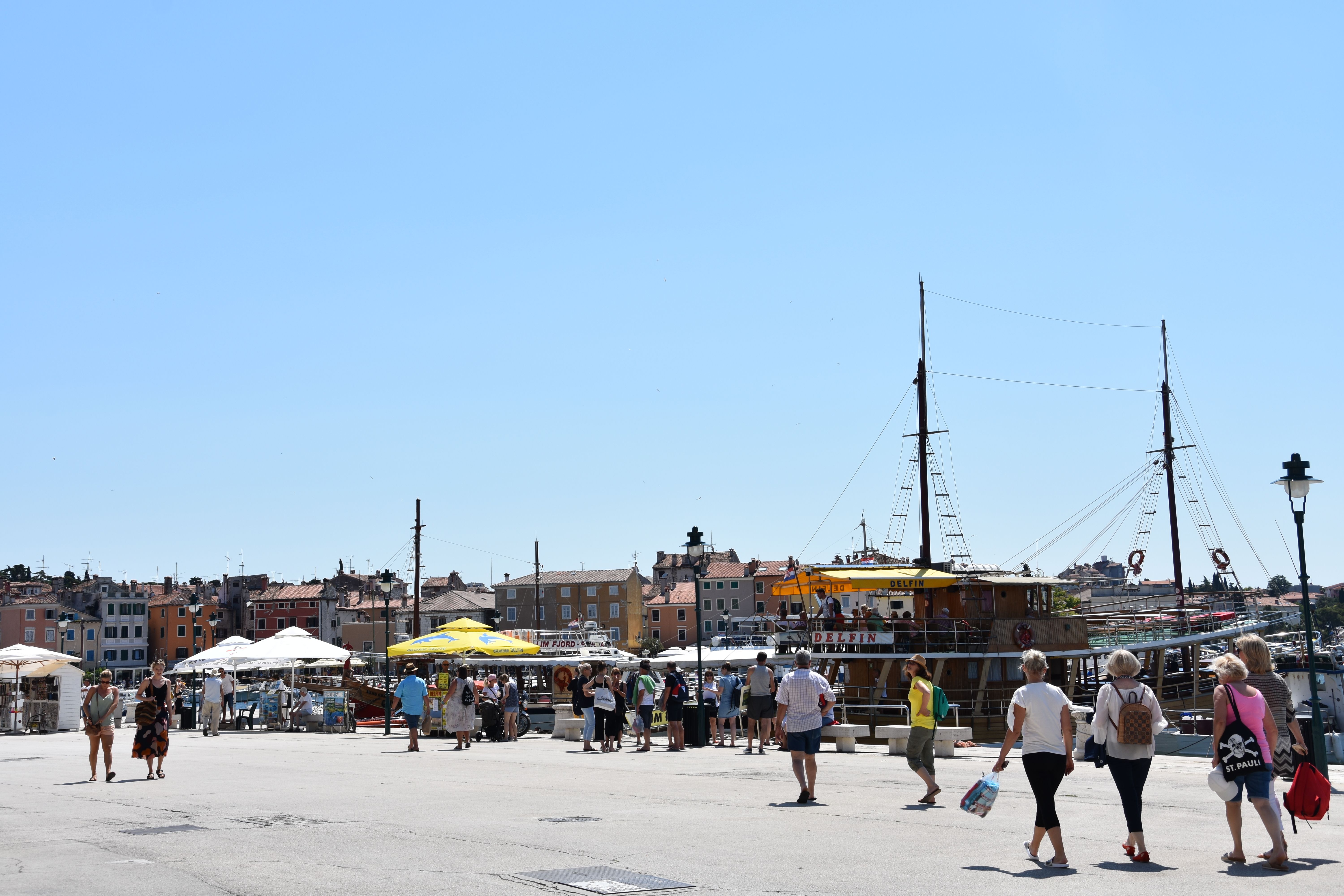
People walking along the bustling waterfront in Rovinj, Croatia under clear blue skies.
List · Croatia 10 picks

The 10 Most Beautiful Small Towns in Croatia (Coast and Hilltops)

From Venetian harbors on the Adriatic to stone villages perched above Istrian vineyards, these are the Croatian towns worth planning a trip around.

Last updated July 15, 202613 min read
Top pick

Rovinj is the best all-rounder for its postcard Old Town and easy Istrian base; choose Korcula for island atmosphere with fewer crowds, or Motovun if you want a quiet hilltop escape inland.

Croatia's beauty isn't only in Dubrovnik and Split. Its smaller towns, the Venetian-tinged harbors of the coast and the stone hill villages of Istria, are where the country feels most itself: church bells over red-tiled roofs, fishermen mending nets, konobas serving whatever came off the boat that morning.

This list ranks ten of the most beautiful, spanning both the Adriatic islands and coast and the interior hills, so you can build a trip around them. Each entry tells you what makes the place special, the specific things to see and eat, who it suits, and how to reach it from the nearest hub city or airport.

Distances in Croatia are manageable: most coastal towns are within two hours of Split or Dubrovnik, and Istria's villages cluster within an hour of Pula or Rovinj. Use the comparison details to match a town to your pace, whether you want a lively harbor or a silent hilltop.

Rovinj1
Rovinj Google
Istria, west coast, about 40 min from Pula
Rovinj is the most photogenic town on the Istrian coast, a cluster of tall pastel houses rising to the baroque bell tower of St. Euphemia's Church on a former island now joined to the mainland. Its Old Town is a maze of steep cobbled lanes, laundry lines, and artist studios that spill toward the harbor where fishing boats still tie up. Come for a sunset aperitivo at the rocks below Grisia street, then eat fresh Adriatic fish and Istrian truffles at a waterfront konoba. It works beautifully as a base for exploring Istria's vineyards, olive groves, and nearby Groznjan and Motovun.
  • Climbing St. Euphemia's bell tower for harbor views
  • Wandering the artists' lane of Grisia street
  • Sunset drinks on the rocks near Valentino bar
  • Fresh fish and Istrian truffle dishes
Best for first-timers to Istria and photographers
Getting there About 40 minutes by car or bus from Pula airport; roughly 3.5 hours by car from Zagreb
Korcula2
Korcula Google
Korcula Island, southern Dalmatia, near Dubrovnik · 4.8 · 2,128 reviews
Often called 'little Dubrovnik,' Korcula Town sits on a small peninsula ringed by medieval walls, its streets laid out in a herringbone pattern designed to block the wind while letting in the sea breeze. The town claims Marco Polo as a native son, and its stone Gothic-Renaissance core centers on St. Mark's Cathedral. It's quieter and more affordable than the big-name towns, with excellent seafood, the crisp white Posip and Grk wines grown on the island, and the sword dance Moreska performed in summer. Surrounding beaches and vineyards make it worth staying a night or two.
  • St. Mark's Cathedral and the herringbone street plan
  • Tasting local Posip and Grk white wines
  • The Moreska sword dance in summer
  • Sunset from a harbor-side wine bar
Best for wine lovers and a relaxed island overnight
Getting there Car ferry or catamaran from Dubrovnik (about 2-3 hours) or from Split (roughly 3 hours by fast catamaran)
Trogir3tours from $52.45
Trogir Google
Central Dalmatia, about 30 min west of Split
Trogir is a UNESCO-listed island town packed into a tiny walled core between the mainland and Ciovo island, easily one of the best-preserved Romanesque-Gothic ensembles in Central Europe. Its showpiece is the Cathedral of St. Lawrence, whose 13th-century Radovan portal is a masterpiece of medieval carving. Small enough to see in a couple of hours, it rewards slow wandering through marble-slick lanes to the Kamerlengo fortress and a stroll along the palm-lined Riva. Its proximity to Split airport makes it a smart first or last stop.
  • Cathedral of St. Lawrence and the Radovan portal
  • Kamerlengo fortress views over the harbor
  • The palm-lined Riva promenade
  • Day trips to nearby Krka waterfalls
Best for history lovers and travelers arriving via Split airport
Getting there About 30 minutes by bus or car from Split; Split airport is only 5-10 minutes away
Motovun4
Motovun Google
Central Istria, about 40 min from Rovinj
Motovun is Istria's iconic hill town, a medieval walled village crowning a vineyard-covered hill with 360-degree views over the Mirna valley, often wrapped in morning mist. The walk up (or short shuttle) leads to a ring of ramparts you can stroll, plus a small square with a Venetian loggia and church. This is truffle country: the surrounding forests yield some of the world's best white truffles, and konobas serve them shaved over fuzi pasta. Come for lunch and the views, and time a visit around the late-July Motovun Film Festival if you can.
  • Walking the medieval town walls for valley views
  • Truffle-topped fuzi pasta in a local konoba
  • Teran red wine from the surrounding hills
  • The Motovun Film Festival in late July
Best for foodies and a quiet hilltop escape
Getting there About 40 minutes by car from Rovinj or Pula; a car is strongly recommended as buses are limited
Cavtat5
Cavtat Google
Southern Dalmatia, about 20 km south of Dubrovnik
Cavtat is the calmer alternative to Dubrovnik, a small resort town wrapped around a horseshoe bay with a palm-lined promenade and two green peninsulas to walk. It has real history beneath the holiday polish: the Racic family mausoleum designed by sculptor Ivan Mestrovic crowns the cemetery hill, and the town was built over ancient Epidaurum. Swim off the rocks, eat well on the waterfront, and take the short boat shuttle into Dubrovnik for the day without paying Old Town prices for your bed. It's also minutes from Dubrovnik airport.
  • The Racic Mausoleum by Ivan Mestrovic
  • Walking the wooded seafront peninsula trails
  • Swimming off the rocky coves
  • Boat shuttle into Dubrovnik's Old Town
Best for a quieter base near Dubrovnik and swimmers
Getting there About 30 minutes by bus or water taxi from Dubrovnik; roughly 10 minutes from Dubrovnik airport
Ston6
Ston Google
Peljesac peninsula, about 1 hour north of Dubrovnik
Ston is a tiny town with an outsized landmark: the longest defensive wall system in Europe, roughly 5 km of ramparts built to protect the medieval salt pans, which you can hike between Ston and neighboring Mali Ston. Those salt pans are still worked by hand today, and the surrounding bay produces some of Croatia's finest oysters and mussels, best eaten shucked at a waterside table in Mali Ston. Pair the seafood with Peljesac's robust Dingac and Postup red wines. It's an easy and rewarding stop on the way to or from the Peljesac vineyards or Korcula ferry.
  • Hiking the 5 km Great Wall of Ston
  • Fresh oysters and mussels in Mali Ston
  • Touring the centuries-old salt pans
  • Dingac and Postup red wines nearby
Best for oyster lovers and active travelers
Getting there About 1 hour by car or bus from Dubrovnik along the Peljesac road
Primosten7
Primosten Google
Central Dalmatia, between Split and Sibenik
Primosten is a compact old town on what was once an islet, its stone houses climbing to St. George's Church at the summit and connected to the mainland by a short causeway. The pebble beaches and clear water draw summer crowds, but the walkable center stays charming, all narrow lanes and sea views. The surrounding hillsides are famous for the Babic red wine grown in dry-stone-walled plots that look like a mosaic from above. It's an easy pause on the coastal road between Split and Sibenik, and the sunsets over the church are memorable.
  • St. George's Church at the town's summit
  • Swimming off Mala Raduca beach
  • Tasting local Babic red wine
  • Sunset views over the causeway
Best for beach days and a scenic road-trip stop
Getting there About 1 hour by car or bus from Split; roughly 30 minutes from Sibenik
Skradin8
Skradin Google
Northern Dalmatia, gateway to Krka National Park
Skradin is a small riverside town at the mouth of the Krka River, best known as the boat gateway into Krka National Park's waterfalls. But it's worth time in its own right: a pretty marina, stone streets climbing to a ruined fortress, and a reputation for good food, including a famous slow-cooked Skradinski rizot. Yachts moor here in summer, yet it stays low-key compared with the coastal resorts. Base here to beat the day-trip crowds into Krka by taking an early park boat upriver.
  • Boat ride upriver into Krka National Park
  • Skradinski rizot, a slow-cooked local risotto
  • Climbing to the hilltop fortress ruins
  • The relaxed marina and riverside cafes
Best for nature lovers visiting Krka waterfalls
Getting there About 1 hour 15 minutes by car from Split; roughly 30 minutes from Sibenik
Groznjan9
Groznjan Google
Northwest Istria, about 30 min from Motovun
Groznjan is a fortified hill village that emptied out after World War II and was reborn as an artists' colony, so its stone lanes are now lined with galleries, studios, and workshops. In summer it hums with music students from the Jeunesses Musicales academy, and you'll hear practice drifting from open windows. It's tiny, walkable in fifteen minutes, and gloriously quiet outside peak hours, with views over vineyards and the Mirna valley. Come for the atmosphere, a coffee on the little square, and Istrian olive oil and wine from the surrounding hills.
  • Browsing the village galleries and studios
  • Live classical music in summer
  • Views over the Mirna valley vineyards
  • Istrian olive oil and wine tastings
Best for art lovers and a slow, quiet afternoon
Getting there About 30 minutes by car from Motovun or 45 minutes from Rovinj; a car is needed
Rab Town10
Rab Town Google
Rab Island, Kvarner Gulf, northern Adriatic
Rab Town is defined by its skyline of four elegant Romanesque bell towers rising from a narrow stone peninsula, one of the most distinctive silhouettes on the Adriatic. The medieval core has three parallel streets terraced up the slope, easy to explore, with sea views at every turn and a leafy park at the tip of the peninsula. Rab Island is greener than the Dalmatian islands, ringed by pine forest and some of the best sandy beaches in Croatia around Lopar. It sees fewer international crowds, making it a rewarding find in the Kvarner region.
  • The four Romanesque bell towers
  • Sandy beaches near Lopar
  • Walking the three terraced old-town streets
  • Komrcar park at the peninsula tip
Best for beach seekers wanting fewer crowds
Getting there Ferry from the mainland at Stinica or Valbiska; about 2.5-3 hours total from Rijeka by car and ferry

Want these spots worked into your trip?

We'll build a custom Croatia itinerary around the places you pick.

Generate itinerary
Good to know

Before you go

When to goLate May, June, and September offer warm water, open restaurants, and thinner crowds than July and August, when coastal towns and ferries are at their busiest and hottest.
Getting aroundA rental car is essential for Istria's hill villages and the most flexible way to link coastal towns; islands like Korcula and Rab are reached by car ferry or faster passenger catamarans that book out in summer.
Book ferries aheadIn peak season, reserve car-ferry and catamaran tickets (via Jadrolinija or Krilo) days in advance, especially for popular island routes from Split and Dubrovnik.
Cash and cardsCroatia uses the euro, and cards are widely accepted, but carry some cash for small konobas, market stalls, and parking machines in smaller towns.

Croatia's small towns let you trade the crowds of the big cities for church bells, fresh oysters, and sea-view lanes with genuine character. Pick one coastal harbor and one inland hill town, link them with a ferry or a scenic drive, and you'll see a side of the country that the day-trippers miss. Build your route around these ten and let the pace of small-town Croatia set the tone.

Frequently asked questions

Which is the most beautiful small town in Croatia?
Rovinj in Istria is the most consistently cited for beauty, with its pastel houses rising to the St. Euphemia bell tower above a working fishing harbor. For an island alternative, Korcula Town offers similar romance with fewer crowds.
Which Croatian small town is best for a day trip?
Trogir is the easiest day trip, just 30 minutes from Split and its airport, and its UNESCO-listed old town can be seen in a couple of hours. Cavtat is the equivalent near Dubrovnik, reachable in about 30 minutes by bus or water taxi.
What is the prettiest hill town in Croatia?
Motovun is Istria's signature hill town, a walled medieval village on a vineyard hill with sweeping views over the Mirna valley and excellent truffle cuisine. Nearby Groznjan is a quieter artists' village worth pairing with it.
Which Croatian towns have the best seafood?
Ston and neighboring Mali Ston are famous for oysters and mussels farmed in the bay, while Skradin is known for its slow-cooked risotto. Both pair well with local Dalmatian wines.
Are Croatia's small towns walkable without a car?
Coastal and island towns like Trogir, Korcula, Cavtat, and Rab are reachable by bus, ferry, or catamaran and are fully walkable once there. Istria's hill villages such as Motovun and Groznjan are much easier with a rental car, as bus service is limited.
Plan with MagicTrips

Build your own Croatia trip

Tell us how many days, your budget, and what you're into. We'll turn it into a custom, day-by-day Croatia itinerary.

Ready to book your stay?

Hotels
Homes

Traveling somewhere else?

Generate a custom itinerary