
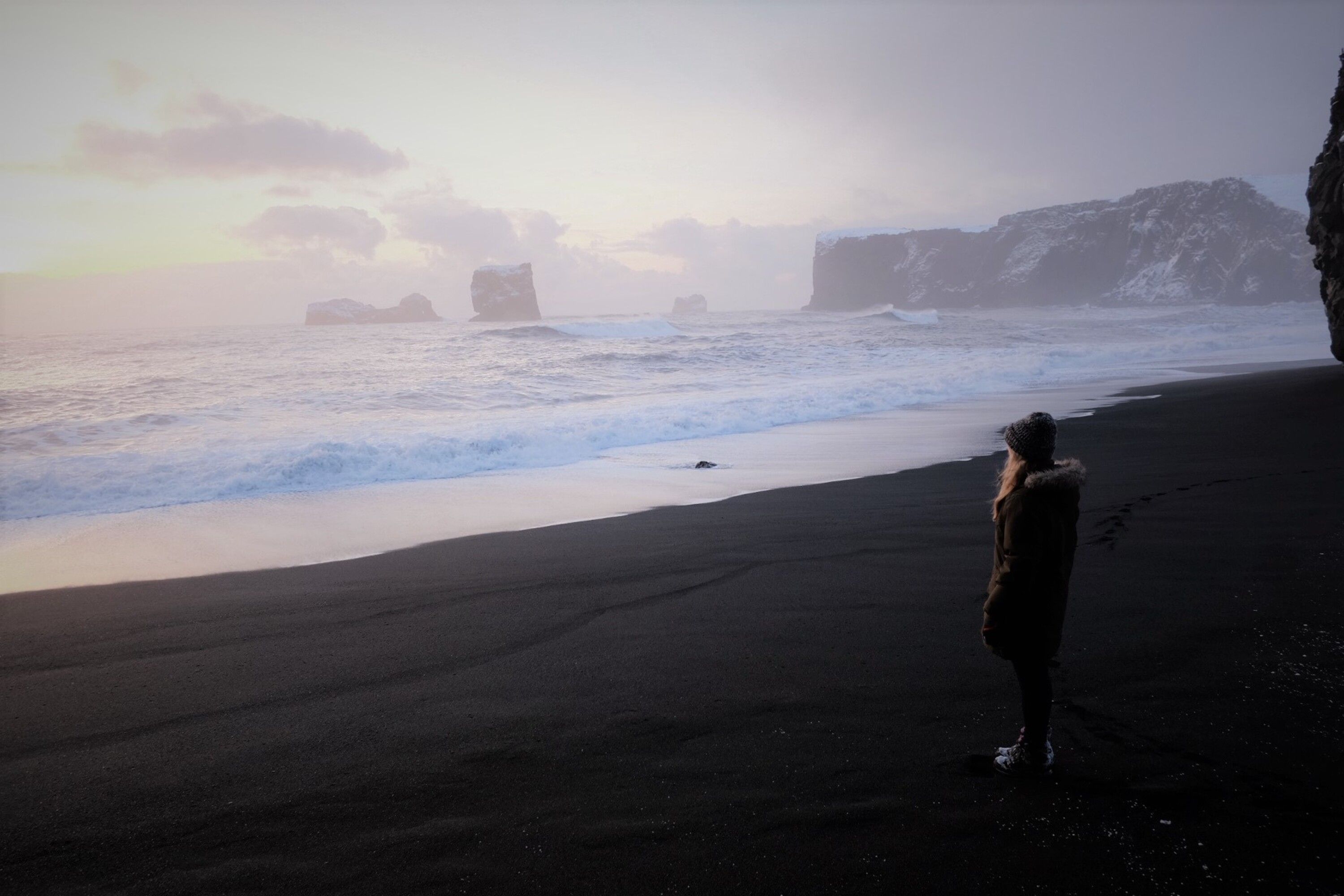
A woman in warm clothing stands on a black sand beach in Iceland, gazing at the ocean waves.
Comparison

Reykjavík vs Vík: Which Iceland Base Is Right for You?

The capital's cafes and culture versus the South Coast's black-sand drama, decoded for your trip.

Last updated June 29, 20265 min read
Quick verdict

Choose Reykjavík for culture, dining, nightlife, and a comfortable base with easy day trips; choose Vík for raw South Coast scenery, black-sand beaches, and waking up next to glaciers and waterfalls.

These two places sit roughly 180 km apart on Iceland's south, but they feel like different planets. Reykjavík is the world's northernmost capital: a compact, colorful city of design shops, geothermal pools, museums, and a famously outsized nightlife and dining scene. Vík í Mýrdal is a windswept village of around 300 people, hemmed in by glaciers, black-sand beaches, and basalt sea stacks, with one church on a hill and not much else, which is exactly the point.

The honest truth is that most Iceland itineraries are not really an either/or. Almost everyone flies into Keflavík near Reykjavík, and many use Vík as a strategic overnight on the South Coast. But if you only have a few days and have to choose a single base, the decision comes down to whether you want urban comfort, food, and easy day trips, or you want to wake up surrounded by raw nature with the big sights on your doorstep.

This comparison breaks down vibe, things to do, food, cost, when to go, and logistics so you can pick the base that matches your trip, and decide how to split your nights between them.

The capital
Reykjavík
Culture · cafes · nightlife
The South Coast village
Vík
Black sand · cliffs · quiet
Head to head

Reykjavík vs Vík

Vibe & first impressions
Reykjavík is small for a capital (around 140,000 people) but lively, with the Hallgrímskirkja church towering over rainbow-painted streets, the waterfront Harpa concert hall, and the buzzing Laugavegur shopping strip. It feels safe, walkable, and creative.
Vík is tiny, exposed, and elemental: a cluster of guesthouses and a famous red-roofed church beneath green cliffs, with Reynisdrangar sea stacks rising offshore. You come for silence, weather, and scenery, not for things to do after dark.
Things to do
Museums (the National Museum, Perlan, the quirky Phallological Museum), geothermal pools like Sundhöllin and Sky Lagoon, whale watching from the old harbor, and a real cafe and gallery scene. Great for rainy-day options.
It is all outdoors: Reynisfjara black-sand beach, the Dyrhólaey arch and puffin cliffs, nearby waterfalls Skógafoss and Seljalandsfoss, and glacier hikes on Sólheimajökull. The village itself you can walk in 15 minutes.
Food & nightlife
Iceland's best dining is here, from fine seafood and lamb tasting menus to hot-dog stands, ramen, and bakeries. Bars on Laugavegur and Austurstræti stay busy until the early hours on weekends; this is the only real nightlife in the country.
A handful of solid restaurants (the Black Beach Restaurant, Suður-Vík, a soup-and-bread cafe) and one small brewery, but options are limited and close early. Nightlife is essentially the northern lights or the stars.
Cost
Iceland is expensive everywhere, but Reykjavík has the widest range, including hostels, budget bakeries, and supermarkets like Bónus to self-cater. More competition keeps some prices in check.
Expect to pay capital-level or higher prices for fewer choices; rural guesthouses and the limited restaurants can be pricey, and the small grocery store has a narrow selection. Stock up before you arrive.
When to go
Year-round. Summer brings near-endless daylight and festivals; winter offers cozy cafes, Christmas markets, and a chance at the aurora over the city, though light pollution dims it.
Best in summer for puffins (roughly May to August) and safe driving, and prime in winter for dark skies and northern lights, since there is almost no light pollution. South Coast weather is notoriously wild, so check road conditions.
Getting there & around
Keflavík Airport is about 45 minutes away by the Flybus or rental car. The city center is walkable, and it is the natural hub for Golden Circle, Blue Lagoon, and South Coast day tours.
About 2.5 hours' drive east of Reykjavík along Route 1, the Ring Road. A car is essentially required; public transport is minimal and most attractions are spread along the highway.
Day trips & touring
Endless: the Golden Circle (Þingvellir, Geysir, Gullfoss), the Reykjanes geothermal area and Blue Lagoon, Snæfellsnes peninsula, and long South Coast day tours, though those mean a lot of driving in one day.
Perfectly placed for the eastern South Coast: Skaftafell in Vatnajökull National Park, the Fjaðrárgljúfur canyon, and the Jökulsárlón glacier lagoon (about 2 hours further east) are far easier reached from Vík than from Reykjavík.

Reykjavík is best for

first-timers, city lovers, foodies, and anyone who wants comfortable lodging, culture, and easy access to day tours in any weather.

Vík is best for

road-trippers and nature seekers who want to wake up beside black-sand beaches and waterfalls and reach the eastern South Coast and aurora-friendly dark skies.

The verdict
Base in Reykjavík, then spend a night or two in Vík on a South Coast loop.

For most travelers this is not a true rivalry: Reykjavík is the obvious arrival hub and comfort base, while Vík is the smart overnight that puts the South Coast's best scenery within reach. If you have three days or fewer, stay in Reykjavík and day-trip; if you have a week or are driving the Ring Road, add at least one night in Vík so you are not rushing the waterfalls, beaches, and glacier lagoon back to the city in the dark.

Decide how many nights you have, then split them: Reykjavík for arrival, food, and culture, Vík for the black-sand drama. Map your South Coast stops and book Vík's limited rooms early, especially in summer.

Frequently asked questions

Is Reykjavík or Vík cheaper?
Both are expensive, as is all of Iceland, but Reykjavík offers more budget options, including hostels, bakeries, and supermarkets for self-catering. Vík has fewer restaurants and lodging choices, so prices there can actually run higher for less variety.
Can you visit both Reykjavík and Vík in one trip?
Yes, and most people do. Vík is about a 2.5-hour drive east of Reykjavík along the Ring Road, making it a natural overnight or stop on a South Coast or full Ring Road itinerary.
Which is better for seeing the northern lights?
Vík has darker skies and far less light pollution, so the aurora is often more vivid there in winter. Reykjavík can still deliver sightings on strong nights, but city lights reduce visibility.
Do I need a car in Vík?
Effectively yes. Vík's main attractions, from Reynisfjara to nearby waterfalls and the glacier lagoon, are spread along Route 1, and public transport is minimal, so a rental car or a guided tour is essential.
Which is better for a first trip to Iceland?
Reykjavík is the easier first base thanks to its proximity to the airport, abundant lodging and dining, and wide range of day tours. Vík rewards travelers who want to slow down in nature and are comfortable driving the South Coast.
Plan with MagicTrips

Build your own trip

Tell us how many days, your budget, and what you're into, and we'll build you a custom, day-by-day itinerary.

Ready to book your stay?

Hotels
Homes

Traveling somewhere else?

Generate a custom itinerary