
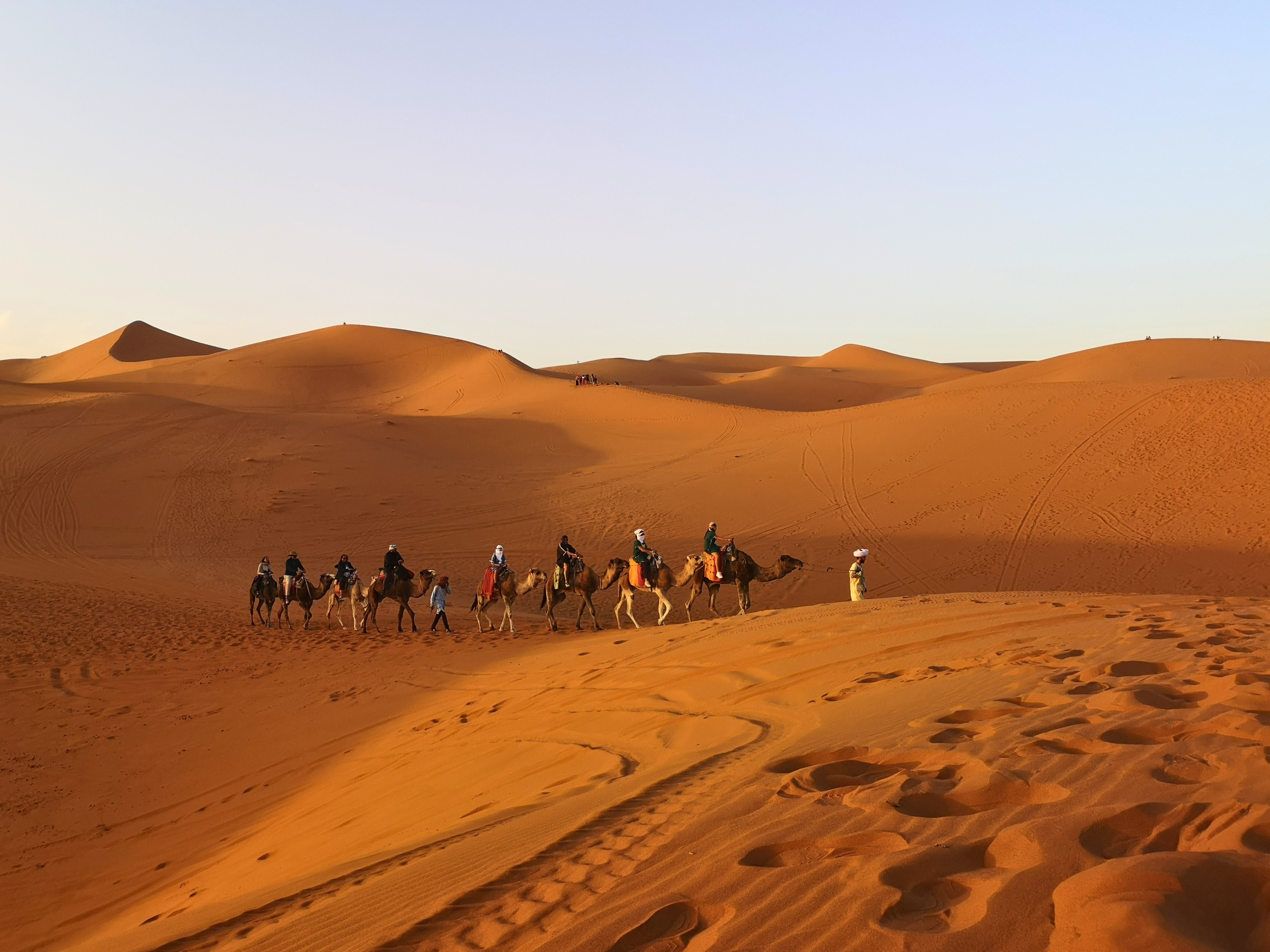
A group of people riding camels across the vast dunes of the Sahara Desert during sunset.
Comparison

Marrakech vs Merzouga: City Medina or Sahara Dunes?

One is a pulsing imperial city of souks and rooftop cafes; the other is a silent sea of orange dunes on the edge of the Sahara. Here's how to choose.

Last updated July 6, 20266 min read
Quick verdict

Choose Marrakech for culture, food, shopping, and a base with an international airport; choose Merzouga for the once-in-a-lifetime Sahara dunes, camel treks, and star-filled desert camps, and combine both if you have four days or more.

These two Moroccan icons are not really rivals so much as two ends of the same trip. Marrakech is a 1,000-year-old imperial city, all clamoring souks, storks on the ramparts, and mint tea on shaded rooftops. Merzouga is a tiny desert village on the western edge of Erg Chebbi, the postcard sea of dunes that rises over 100 meters near the Algerian border. One overwhelms your senses; the other empties them out.

The practical catch is distance: they sit roughly 550 km apart, an eight-to-ten-hour drive over the High Atlas via the Tizi n'Tichka pass. That means this is rarely a genuine either/or for a first Morocco trip. Most travelers use Marrakech as the arrival hub and Merzouga as the payoff at the far end of a two-to-four day desert tour.

Still, if your time or energy only stretches to one, the character of each is wildly different, and knowing which experience you actually want will save you a lot of driving and second-guessing.

The imperial city
Marrakech
Souks · rooftops · sensory overload
The Sahara gateway
Merzouga
Dunes · silence · desert nights
Head to head

Marrakech vs Merzouga

Vibe & first impressions
Intense, theatrical, and relentless in the best and worst ways: the Jemaa el-Fnaa square erupts each evening with food stalls and musicians, while the labyrinthine medina assaults you with color, scent, and constant hustle. It rewards you but rarely lets you rest.
The opposite extreme: a scattering of low kasbah-style guesthouses at the foot of towering dunes, with near-total silence once you walk into the sand. First impression is the scale and stillness of Erg Chebbi glowing at sunrise and sunset.
Things to do
Days of it: Bahia Palace, the Saadian Tombs, the Ben Youssef Madrasa, Majorelle Garden and the YSL Museum, endless souks, hammams, and cooking classes. Easily fills three or four full days.
The dunes are the show. Camel trekking to a desert camp, 4x4 dune bashing, sandboarding, visiting Gnawa and Berber musicians in nearby Khamlia, and quad biking. Rewarding but essentially a one-to-two night experience.
The signature experience
Losing yourself in the medina and emerging onto a rooftop terrace at dusk as the call to prayer rolls across the city and the square below fills with smoke and lights.
Riding a camel over the crest of Erg Chebbi at sunset, sleeping in a canvas camp under an unpolluted sky thick with stars, then climbing a dune to watch the sun rise over the Sahara.
Food & nightlife
Excellent and varied: tagines and pastilla in the medina, refined Moroccan-French dining in Gueliz, rooftop bars, and the legendary street-food circus of Jemaa el-Fnaa. Real nightlife exists if you want it.
Simple and communal. Meals are home-style tagines, bread, and mint tea at your guesthouse or camp, often shared around a fire with drumming. There is no nightlife beyond the stars and a djembe.
Cost
Wide range: hostel dorms and cheap riads exist alongside luxury boutique stays. You can eat well for a few euros or splurge freely, so it flexes to any budget.
Desert camps span from basic bivouacs to plush 'luxury' tents with private bathrooms; a night with camel trek, dinner, and breakfast is generally very good value. Most people arrive on a multi-day tour where transport, meals, and camp are bundled into one price.
When to go
Spring (March-May) and autumn (September-November) are ideal. July and August are brutally hot, often 38-42C, though rooftops and pools help; winters are mild and pleasant.
Same shoulder seasons win. Summer daytime heat in the Sahara can exceed 45C and is genuinely dangerous for midday treks; winter days are lovely but desert nights turn cold, so pack layers year-round.
Getting there & around
Marrakech Menara Airport has direct flights across Europe and beyond, and the city is compact and walkable (chaotic, but walkable). It is the natural start and end point.
No airport and no rail; you arrive by road, usually via a two-to-three day tour through Ait Benhaddou, the Dades and Todra gorges, then Merzouga. Fastest option is a domestic flight to Errachidia or Ouarzazate plus a transfer, but almost everyone drives.
Combining the two
Works best as your anchor: fly in, spend two or three days, then depart on a desert loop and return to catch your flight home.
Fits neatly as the climax of a 3-4 day round trip from Marrakech, or a longer route ending in Fes. Doing Merzouga as a rushed overnight from Marrakech means far too many hours in a vehicle.

Marrakech is best for

travelers who want culture, food, shopping, and architecture in a lively city that doubles as a convenient arrival hub.

Merzouga is best for

travelers chasing the classic Sahara experience: dune sunrises, camel treks, and a night in a desert camp under the stars.

The verdict
Base in Marrakech, then earn the dunes at Merzouga.

For most trips this is not a competition: Marrakech is where you land and soak up Moroccan city life, and Merzouga is the reward at the end of a desert journey across the Atlas. If you truly must pick one and it's your first time, choose Marrakech for depth and ease; if you've seen cities and crave the Sahara above all, commit to the drive and go to Merzouga.

Sketch out how many days you have: two to three lean toward Marrakech alone, four or more open up the desert. Either way, start planning the route across the Atlas and you'll have both the city and the Sahara within reach.

Frequently asked questions

Is Marrakech or Merzouga cheaper?
Day-to-day costs are similar and both flex to your budget, but Merzouga is usually experienced via a bundled tour that includes transport, meals, and a camp, which can make it feel pricier per day. Marrakech offers more cheap-eat and budget-bed options if you're economizing.
Can you visit both Marrakech and Merzouga in one trip?
Yes, and most people do. The standard route is a 3-4 day round trip or one-way tour from Marrakech through Ait Benhaddou and the gorges to Merzouga, so plan for significant driving time each way.
How long is the drive from Marrakech to Merzouga?
It's roughly 550 km and takes about 8-10 hours nonstop over the High Atlas via the Tizi n'Tichka pass. Almost no one does it in one go; tours break it across two days with scenic stops.
Which is better for a first trip to Morocco?
Marrakech is the easier and more complete first stop thanks to its airport, culture, food, and range of accommodation. Merzouga is best added as the highlight of a desert extension rather than a standalone base.
Is Merzouga worth the long journey?
For most travelers, yes: Erg Chebbi is the most accessible stretch of true Saharan dunes in Morocco, and a night in a desert camp is a trip highlight. If you only have a couple of days total, though, the drive may not be worth it.
Plan with MagicTrips

Build your own trip

Tell us how many days, your budget, and what you're into, and we'll build you a custom, day-by-day itinerary.

Ready to book your stay?

Hotels
Homes

Traveling somewhere else?

Generate a custom itinerary